
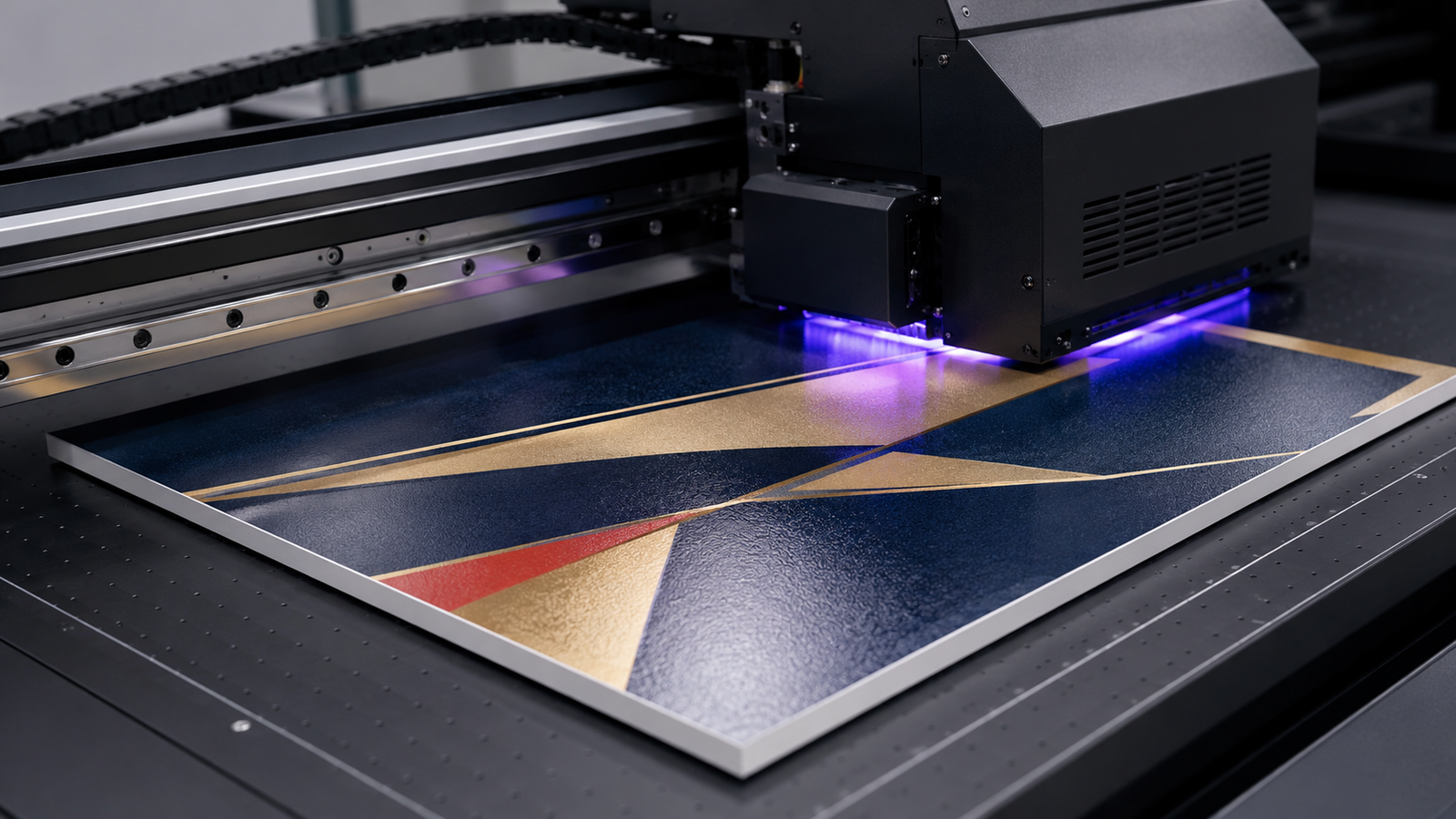
UV printing has quietly become one of the most versatile branding methods available in the UAE, yet it is still the one buyers understand least. If you have ever wondered how a full-colour logo ends up printed directly onto a metal pen, an acrylic award, a phone case or a rigid sign board, the answer is usually UV printing. This guide explains what UV printing is, how it differs from UV DTF, what it does well, where it falls short, and how to decide whether it is the right method for your branded product. It is part of our wider guide to branding and printing methods.
What is UV printing?
UV printing is a digital printing process that uses special inks cured (hardened) instantly by ultraviolet light. Instead of soaking into a surface and drying over time like conventional ink, UV ink is flashed with UV lamps the moment it is laid down, so it bonds to the surface as a thin, tough, colour-fast layer. Because the ink cures instantly and sits on top of the material, UV printing can put a sharp, full-colour image directly onto surfaces that ordinary printing cannot handle — rigid, smooth, non-absorbent materials included.
The most common form for branded products is UV flatbed printing, where the item is placed on a flat bed and printheads pass over it. This is how logos and full-colour artwork are applied directly to pens, power banks, drinkware, acrylic, wood, metal, signage panels and more. Mustang Advertising runs UV flatbed printing in-house in Dubai, which is why so many hard-surface items can be branded under one roof.
UV printing vs UV DTF
UV DTF (direct-to-film) is a newer cousin of UV printing, and the two are often confused. The difference is how the image reaches the product.
| UV flatbed printing | UV DTF (direct-to-film) | |
|---|---|---|
| How it works | Prints ink directly onto the item on a flat bed | Prints onto a film, then transfers the cured design onto the item as a sticker-like layer |
| Best for | Flat or gently curved rigid items — signage, acrylic, metal, wood | Curved and irregular items — bottles, mugs, cylinders, uneven surfaces |
| Finish | Image sits directly on the surface, very durable | Durable transferred layer that conforms to curves |
| Feel | Can add a slight raised texture with layered ink | Thin, flexible, follows the shape of the item |
In practice, UV flatbed is the workhorse for flat and rigid items, while UV DTF solves the problem of branding curved and awkward shapes in full colour. A good supplier will pick whichever suits your item — you do not need to specify the exact machine, only the product and the result you want.
What UV printing does well
- Full colour, including photographic detail — gradients, fine detail and multi-colour logos print in one pass without separate screens.
- Prints on almost anything — metal, acrylic, wood, glass, leather, plastic and rigid board, not just paper and fabric.
- Durable and colour-fast — the cured ink resists scratching, water and fading, which matters in the UAE’s sun and heat.
- Fast for short runs — no screens or setup plates to make, so it is economical for small quantities and one-offs.
- Special effects — layered white ink for printing on dark or clear surfaces, and raised or textured finishes are possible.
Where UV printing is not the right choice
No method is universal. UV printing is less suited to garments and soft textiles, where screen printing, direct-to-garment printing or embroidery are the right tools. For very large volumes of a simple one- or two-colour design on flat stock, screen printing can be cheaper per unit. And where a premium engraved look is wanted on metal or acrylic — such as awards — laser engraving may be preferable to a printed finish. The art is matching the method to the material and the goal, which is exactly what the branding methods guide is designed to help you do.
How to get the best UV print
- Supply vector artwork where possible so the print is crisp at any size; high-resolution raster files also work for photographic images.
- Specify brand colours as Pantone references — UV is digital CMYK, so a Pantone target lets the supplier match as closely as the process allows.
- Approve a sample on the actual material — the same ink looks different on white acrylic, brushed metal and dark plastic.
- Discuss white-ink underbase for dark or transparent items, so colours stay vivid.
- Confirm the print area and curvature — flatbed suits flat/rigid; curved items may need UV DTF instead.
Typical UV-printed products
UV printing is behind a huge share of modern branded merchandise and signage: metal and plastic pens, power banks, USB drives, drinkware, phone accessories, acrylic and metal awards, desk items, keychains, signage and display panels, and rigid point-of-sale pieces. If an item is hard-surfaced and needs a full-colour logo, UV printing is usually the answer. For large-format and signage applications specifically, see how signage and digital printing drive brand visibility.
UV printing vs screen printing on hard items
On flat, rigid items a common question is whether to UV print or screen print. Both are excellent, but they win in different situations.
| UV printing | Screen printing | |
|---|---|---|
| Colours | Full colour, gradients and detail in one pass | Best for a limited number of solid spot colours |
| Setup | No screens — fast for short runs and one-offs | Screen setup per colour — economical at higher volumes |
| Detail | Fine detail and photographic images | Bold, simple graphics |
| Best when | Multi-colour logos, small-to-medium runs, varied items | Large volumes of a simple design on the same item |
In short: reach for UV when the design is colourful or the run is short and varied; consider screen printing when you are producing large volumes of a simple, few-colour design. The methods guide walks through the full comparison.
Cost and quantity: when UV makes sense
Because UV printing needs no screens, plates or per-colour setup, it is unusually cost-effective for small quantities, samples and one-off personalised items — there is no large fixed cost to spread. It also handles mixed orders well, since each item can carry different artwork without extra setup. For very large runs of a single simple design, other methods may edge ahead on unit cost, but for the colourful, varied, short-to-medium runs typical of corporate merchandise, UV is often both the highest-quality and the most economical choice. As always, ask your supplier to quote the specific item and quantity, and to recommend the method that gives the best result for your budget — the principles of getting good advice are in how to choose a supplier.
Talk to a UV printing specialist in Dubai
Mustang Advertising runs in-house UV flatbed printing in Dubai and has branded hard-surface products for UAE businesses since 2007. Learn about the group on our companies page, contact the team for advice on your item, or browse products and request a quote on our B2B catalogue at giftsuppliers.ae. Not sure which method fits your product? Start with the complete branding and printing methods guide, and if you are choosing a supplier, our guide on how to choose a supplier will help.
Frequently asked questions
What is UV printing? A digital printing process that uses inks cured instantly by ultraviolet light, bonding a tough, full-colour, colour-fast layer directly onto surfaces — including metal, acrylic, wood and plastic — that ordinary printing cannot handle.
What is the difference between UV printing and UV DTF? UV flatbed prints directly onto flat, rigid items; UV DTF prints onto a film that is then transferred onto curved or irregular items such as bottles and mugs. The supplier chooses whichever suits your product.
Is UV printing durable in the UAE climate? Yes — the cured ink resists scratching, water and fading, which makes it well suited to the UAE’s sun and heat, especially for signage and outdoor-facing items with the right materials.
Can you UV print in full colour and on dark items? Yes — UV prints full colour including photographic detail, and a white-ink underbase lets colours stay vivid on dark or transparent surfaces.
Is UV printing good for garments? No — for fabrics use screen printing, direct-to-garment printing or embroidery. UV printing is for hard and rigid surfaces.
Can UV printing be done on curved items? Flat UV printing suits flat and rigid items; for curved or irregular items such as bottles and mugs, UV DTF transfers the design so it conforms to the shape. The supplier selects the right approach for your item.
Does UV printing have a minimum order? Because there are no screens or setup plates, UV printing is economical even for small quantities and one-offs. Minimums depend on the item rather than the printing method — ask your supplier for the specific product.
Is a UV print waterproof and scratch-resistant? The cured ink is durable and resists water and scratching well, which suits everyday items and outdoor-facing products when the right base material is used.