
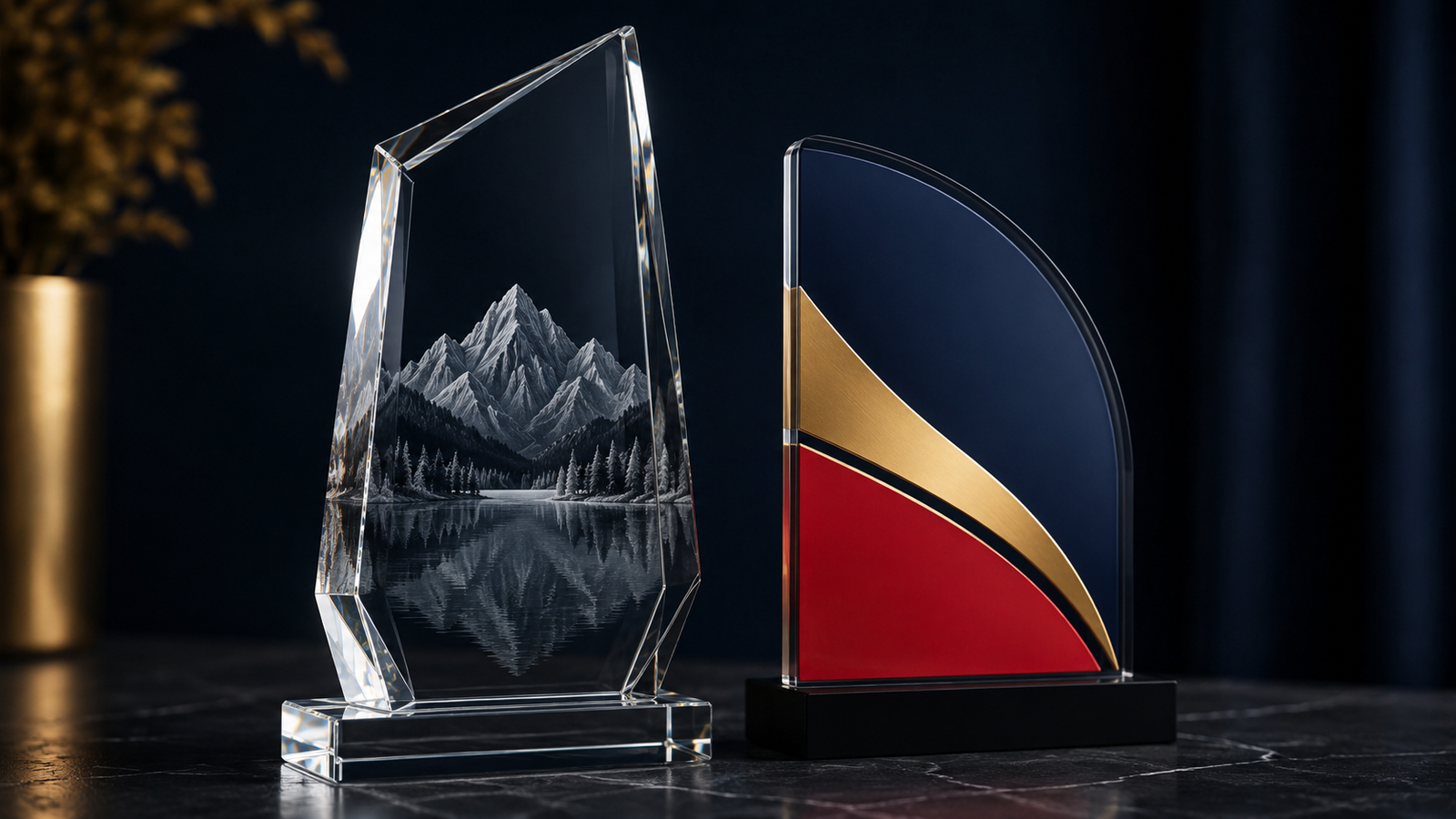
Understanding engraving vs printing on awards is what lets you get the finish, durability and look you want on a trophy or plaque without paying for the wrong method. The two dominate award decoration in the UAE, and each suits different materials, designs and budgets. This guide explains how each works, when to use it, and how to combine them for the best result.
Engraving vs printing on awards — the basics
Engraving physically marks the surface — a laser or tool removes or alters material to create text and logos, giving a permanent, tactile, understated finish. Printing lays colour onto the surface, most often via UV printing, allowing full-colour logos and detailed artwork. Engraving is prized for its permanence and premium restraint; printing wins where colour and detail matter.
| Factor | Engraving | Printing (UV) |
|---|---|---|
| Look | Permanent, tactile, understated | Full-colour, detailed, vibrant |
| Colour | Usually single-tone / frosted | Full colour, gradients, photos |
| Durability | Extremely durable — part of the surface | Durable; sits on the surface |
| Best materials | Crystal, metal, glass, wood | Acrylic, wood, metal, coated surfaces |
| Best for | Prestige awards, text, logos | Colour logos, complex artwork |
When to choose engraving
Engraving is the premium default for prestige awards. It reads as understated and timeless, never fades or peels, and gives crystal, glass and metal that classic frosted or etched finish. It is ideal for text-led awards, single-colour logos and long-service honours where permanence and restraint matter. Laser engraving in particular produces crisp, precise detail; our laser engraving guide explains the process. For most flagship crystal and metal awards, engraving is the natural choice.
When to choose printing
Printing wins whenever colour is essential. A multi-colour logo, a sponsor’s brand colours, or detailed artwork all reproduce far better with UV printing than engraving can manage. UV print handles gradients, photos and fine full-colour detail, and works well on acrylic, wood and coated surfaces. Our UV printing guide covers how it performs. For team awards, event awards with sponsor logos, and anything where brand colour must be exact, printing is the better route.
Combining engraving and printing
The two are not mutually exclusive, and the best awards often use both. A common approach is to engrave the recipient’s name and details for a permanent, tactile record while printing a full-colour company or event logo for brand impact. This combination delivers prestige and colour at once. The right mix depends on the material, the design and the budget — a good producer will advise on what each method achieves on your chosen award. Our branding and printing methods guide and quality and production guide help you specify and proof the finish before production, and choosing an in-house producer with both laser and UV capability means one partner delivers a consistent result. Explore ready options in the awards and trophies range.
Getting artwork right for awards
Whichever method you choose, the quality of the finished award depends on the artwork behind it. Supply your logo as a vector file so it reproduces cleanly at any size, whether engraved or printed. For engraving, remember that fine detail and very thin lines can be lost, so a simplified, bold version of a logo often engraves better than an intricate one — a good producer will advise and provide a proof. For UV printing, specify colours precisely, ideally to a Pantone reference, so brand colour reproduces consistently across every award and every reorder. Always approve a proof — a digital mock-up or, for important awards, a physical sample — before the full run. Catching a spelling error in an engraved name or a colour mismatch at proof stage costs nothing; discovering it on finished awards at a ceremony is an expensive and visible mistake.
Spelling and detail accuracy deserve special attention on awards, because a recipient’s name or title rendered incorrectly undermines the entire gesture. Double-check names, dates, titles and spellings against a confirmed list before approving production, and have a second person verify. This simple discipline prevents the most common and most embarrassing award errors.
Choosing a method by material and budget
In practice, the material often narrows the choice for you. Crystal and glass awards are almost always engraved, because engraving suits them beautifully and printing on clear crystal is less effective. Acrylic and wood are versatile and take both engraving and UV print well, giving you a free choice based on whether colour matters. Metal is typically engraved or etched. Budget then fine-tunes the decision: engraving a single-tone logo is straightforward, while full-colour printing adds cost but delivers brand colour where it counts. For a tiered recognition programme, a practical pattern is engraving on the premium crystal and metal awards for timeless prestige, and UV printing on acrylic team awards where colourful, brand-led designs work well. Matching method to material and budget this way gives every award the best possible finish for its role and price point, and an in-house producer running both laser engraving and UV printing can deliver the whole tiered set to a consistent standard from a single brief.
Durability and long-term appearance
Awards are meant to last — often displayed for years on a desk or in a trophy cabinet — so how each decoration method ages matters. Engraving is effectively permanent: because the mark is cut into the surface itself, it cannot fade, peel or wear away, which is why it is the default for prestige awards intended to be kept for a lifetime. UV printing is also durable and holds up well indoors, though as a surface-applied layer it is theoretically more exposed to wear over very long periods than engraving. For awards that will live in protected indoor display, both methods perform reliably. For the highest-value, keepsake awards where permanence is part of the meaning, engraving has the edge. Where colour is essential, quality UV printing on a suitable material still delivers a long-lasting, professional result. The practical takeaway is to let the award’s intended lifespan and display setting inform the method: permanent engraving for lifetime keepsakes and single-tone prestige, quality UV print where full colour carries the design.
Whichever route you choose, specifying quality materials and a reputable producer is what ultimately protects the finish over time. A cheap award with a poorly applied print or shallow engraving disappoints within months, while a well-made award — correctly decorated on a quality base — looks as good years later as it did on presentation day, quietly reinforcing the prestige of your recognition programme every time it is seen. Investing a little care in material, method and proofing is the surest way to ensure every award you hand over reflects well on both the recipient and the company presenting it. Get the method, material and detail right, and the award will carry your recognition with the permanence and prestige it deserves for years to come, standing as a lasting mark of the achievement it was created to celebrate and a credit to the organisation that presented it with such evident care and attention to quality throughout the entire production, decoration and presentation process from start to finish.
Frequently asked questions
Is engraving or printing better for awards?
Engraving is best for prestige, permanence and single-tone finishes on crystal, glass and metal. Printing (UV) is best for full-colour logos and detailed artwork on acrylic, wood and coated surfaces. Many awards combine both.
What is award engraving?
Engraving physically marks the award surface — usually with a laser — to create permanent, tactile text and logos. It gives crystal, glass and metal a classic frosted or etched finish that never fades or peels.
Can you print full colour on awards?
Yes. UV printing reproduces full-colour logos, gradients and detailed artwork on awards, and works well on acrylic, wood, metal and coated surfaces. It is the best method when exact brand colour matters.
Which method is more durable?
Both are durable. Engraving is extremely durable because the mark is part of the surface itself and cannot fade or peel. UV print is also durable but sits on the surface. For maximum permanence, engraving leads.
Can an award be both engraved and printed?
Yes, and this is often the best result. A common approach engraves the recipient’s name for permanence while printing a full-colour company or event logo for brand impact, combining prestige and colour.
Which materials suit engraving?
Crystal, glass, metal and wood all engrave well. Crystal and glass take laser and sub-surface engraving for a premium frosted effect, while metal is typically laser-engraved or etched.
How do I choose between engraving and printing?
Base it on the design and material: choose engraving for prestige, text and single-tone logos on crystal or metal; choose printing for full-colour or detailed artwork on acrylic or wood. Combine them when you need both.
Talk to our team — free consultation
Call or WhatsApp one of our team members now for a free consultation:
- Ms Bonita — +971 55 432 6712
- Mr Jaleel — +971 55 959 9806
- Mr Shoaib — +971 55 265 8802
- Email — [email protected]