
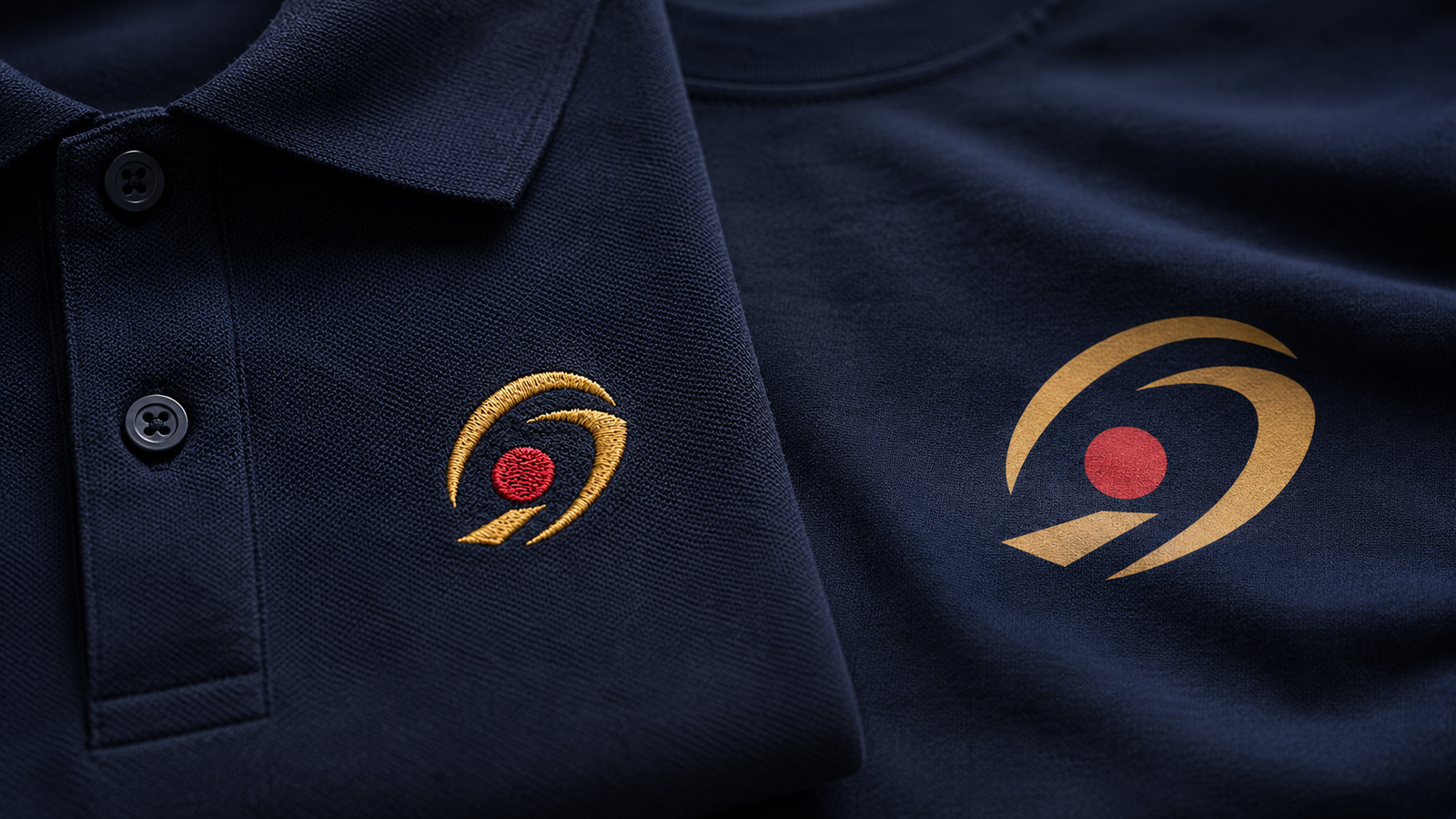
The right choice among the main uniform branding methods — embroidery, screen printing, heat transfer and others — decides how professional your team looks and how long that branding survives daily wear and washing. Putting a logo on a uniform sounds simple, but the decoration method affects cost, durability, appearance and which fabrics and designs are possible. This guide compares the main methods used in the UAE so you can brief your supplier with confidence and get a result that still looks sharp months later.
The main uniform branding methods compared
Each decoration method suits different logos, fabrics, quantities and budgets. The two workhorses for UAE uniforms are embroidery and screen printing, with heat transfer and other methods filling specific niches.
| Method | Best for | Durability | Notes |
|---|---|---|---|
| Embroidery | Logos on polos, shirts, caps, jackets | Excellent | Premium, textured look; ideal for left-chest logos |
| Screen printing | Larger designs, higher quantities | Very good | Cost-effective at volume; setup per colour |
| Heat transfer / vinyl | Names, numbers, small runs | Good | Flexible for personalisation; good for small quantities |
| DTF / digital transfer | Full-colour, detailed designs | Good | Handles complex artwork and photos |
| Sublimation | All-over prints on polyester | Excellent | Dye becomes part of the fabric; polyester only |
For a standard corporate uniform with a chest logo, embroidery is usually the premium default — durable and professional. For larger back prints or high volumes, screen printing is more economical. For individual names and numbers, heat-applied vinyl is flexible and cost-effective in small runs.
Embroidery versus screen printing
This is the decision most UAE uniform buyers face. Embroidery stitches the logo into the fabric, giving a raised, textured, premium finish that lasts the life of the garment and reads as high quality — ideal for polos, shirts, caps and outerwear. Screen printing lays ink onto the fabric, which is more cost-effective for larger designs and higher quantities but involves a setup charge per colour and is better suited to flat, simpler artwork. Our detailed guide on how embroidery and screen printing enhance brand identity and our introduction to screen printing go deeper on each.
- Choose embroidery for chest logos, premium roles, caps and durability that survives heavy washing.
- Choose screen printing for large prints, event tees and high volumes where per-unit cost matters.
- Choose heat transfer for names, numbers and small personalised runs.
- Match method to fabric — some methods suit cotton, others polyester; confirm with your producer.
How branding method affects cost
Embroidery is priced largely by stitch count (design size and complexity), with a one-off digitising charge to convert your logo into a stitch file. Screen printing is priced per colour with a setup charge per colour per design, so it becomes cheaper per unit as quantities rise. Heat transfer has low setup but higher per-unit cost, making it ideal for small runs and personalisation. Understanding this is how you avoid paying screen-print setup for a run too small to justify it, or embroidering a huge back logo that would print far more cheaply. As an in-house producer, we run embroidery, screen printing and heat presses under one roof — see our branding and printing methods guide for the full picture.
For garments to decorate, browse the apparel and accessories range and headwear options, or explore the textile range for bulk uniform bases.
Placement and logo design for uniforms
Where you place branding matters as much as the method. The left chest is the classic, versatile position for a company logo — visible, professional and suitable for embroidery. Sleeves and the upper back suit secondary marks, taglines or larger designs. Caps carry front or side embroidery. Before decorating, make sure your logo works at uniform scale: fine detail and thin lines that look crisp on a business card can disappear or clog when embroidered small or printed on textured fabric. Simplifying a logo into a clean, single-colour or limited-colour version for garments often produces a far better result than forcing a complex full-colour logo onto every shirt. A good producer will advise on this and provide a digitised proof before running the full order.
Consistency across the uniform range is what makes a team look genuinely coordinated. Decide logo size, colour and position once, document it, and apply it identically across shirts, polos, jackets and caps. This is especially important when different garments use different decoration methods — an embroidered polo logo and a printed jacket logo should still read as the same brand at a glance. Keeping a simple branding specification on file means every reorder and every new garment style matches, protecting a professional, unified appearance as your team and uniform range grow.
Choosing a method by quantity and budget
Quantity is often the deciding factor between methods. For small teams and low quantities, embroidery and heat transfer avoid the per-colour setup costs of screen printing and remain economical. As quantities climb into the hundreds, screen printing’s per-unit cost drops sharply, making it the value choice for large uniform runs and event apparel with simple, flat designs. For mixed needs — a durable embroidered chest logo plus occasional printed event tees — many UAE businesses use more than one method across their programme. The practical approach is to brief your producer on your logo, fabrics, quantities and budget together, and let them recommend the optimal method for each garment rather than defaulting to a single method for everything. Working with an in-house producer that runs embroidery, screen printing and heat presses under one roof means you get impartial advice and a coordinated result, without pieces being outsourced to different decorators with inconsistent quality.
Getting artwork and proofs right
The quality of your branding is only as good as the artwork behind it. For the sharpest result, supply your logo as a vector file (such as AI, EPS or PDF) rather than a low-resolution image, so it can be scaled and reproduced cleanly at any size. For embroidery, the logo is converted into a digitised stitch file — a one-off process — and a good producer will provide a stitch-out or digital proof for approval before running the full order. For screen printing, colours should be specified precisely, ideally to a Pantone reference, so your brand colour reproduces consistently across every garment and every reorder. Always approve a physical or digital proof before volume production; catching a placement, size or colour issue at proof stage costs nothing, whereas discovering it across hundreds of finished garments is an expensive mistake. Keeping approved artwork, stitch files and colour references on file also means every future reorder matches the original exactly, protecting brand consistency as your uniform programme grows and garments are replaced over time. Investing a little care at the artwork and proofing stage is the single cheapest way to guarantee a professional, uniform result across your whole team, order after order, and it protects the reputation your branded uniforms are meant to build across every customer interaction, and it keeps every reorder matching the first without repeated proofing effort on your side, which is exactly what a consistent, professional brand image depends on over the long term.
Frequently asked questions
What are the main uniform branding methods?
The main methods are embroidery, screen printing, heat transfer/vinyl, DTF digital transfer and sublimation. Embroidery and screen printing are the two workhorses for UAE corporate uniforms.
Is embroidery or screen printing better for uniforms?
Embroidery is best for chest logos, caps and premium, durable finishes. Screen printing is more cost-effective for larger designs and high quantities. Many uniforms use embroidery for the logo and other methods for names or large prints.
Which branding method lasts longest?
Embroidery and sublimation are the most durable. Embroidery is stitched into the fabric and survives heavy washing; sublimation dyes the polyester fibres themselves. Both typically last the life of the garment.
How is embroidery priced?
Embroidery is priced mainly by stitch count — larger, more detailed logos cost more — plus a one-off digitising charge to convert your logo into a stitch file. Reorders of the same design avoid repeat digitising.
Why does screen printing have a setup charge?
Screen printing requires a separate screen for each colour in the design, which is a one-off setup cost per colour. This is why it becomes more economical as quantities increase and simpler designs cost less.
Can I put names and numbers on uniforms?
Yes. Heat-applied vinyl is the usual method for individual names and numbers because it is flexible and cost-effective in small quantities, and can be combined with an embroidered or printed logo.
Does the fabric affect which branding method I can use?
Yes. Some methods suit natural fibres like cotton, while sublimation works only on polyester. Always confirm the method suits your chosen fabric with your producer before ordering.
Talk to our team — free consultation
Call or WhatsApp one of our team members now for a free consultation:
- Ms Bonita — +971 55 432 6712
- Mr Jaleel — +971 55 959 9806
- Mr Shoaib — +971 55 265 8802
- Email — [email protected]