
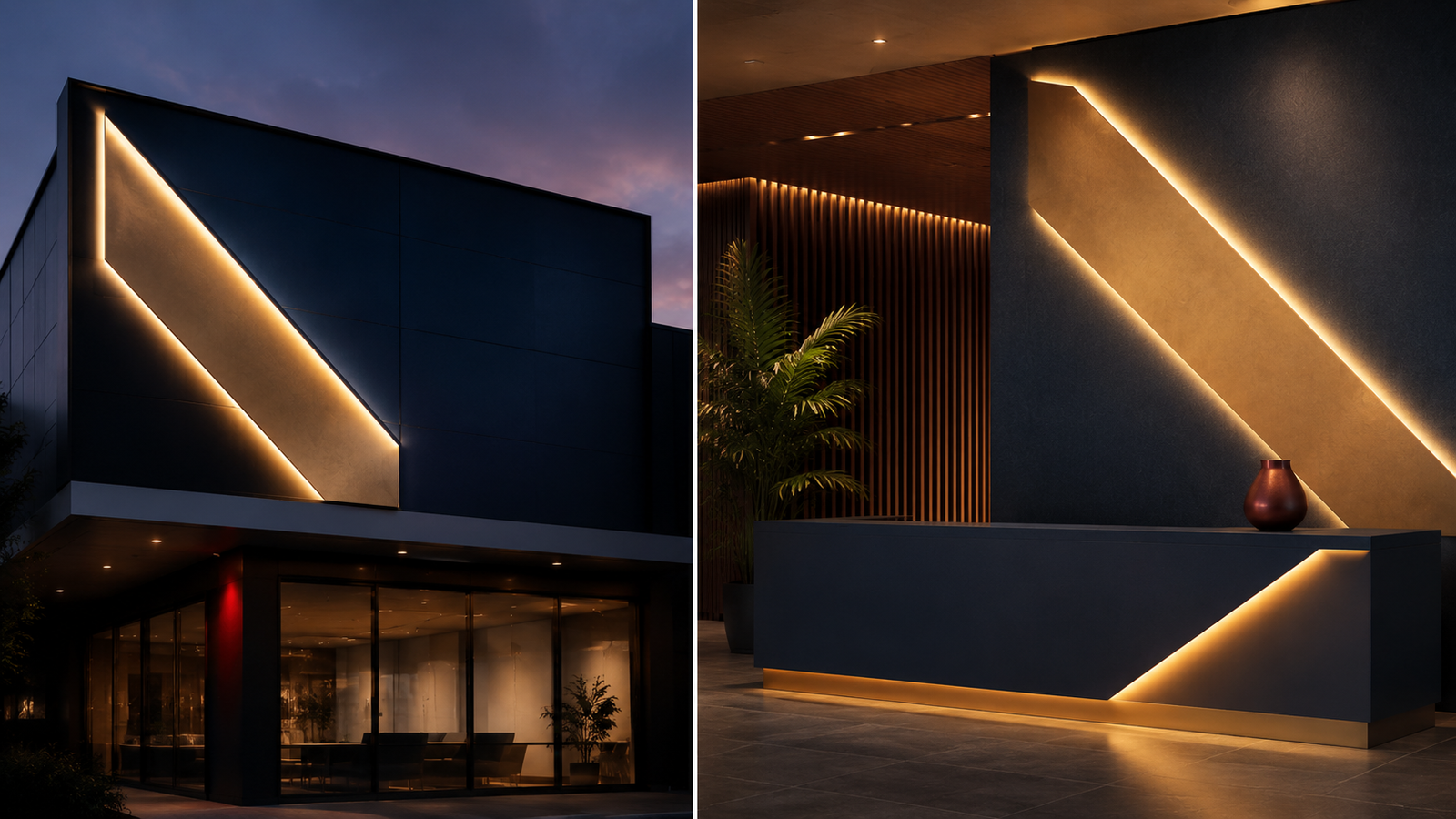
Signage is the branding that works when nobody is watching. A shopfront fascia, a reception logo, a wayfinding board or an exhibition backdrop sells, guides and reassures around the clock — or, if it is badly specified, it fades, peels, buckles in the heat and quietly damages the brand instead. This guide is written for the buyer signing off signage in the UAE: marketing managers, facilities and operations teams, retailers and event organisers who need to choose the right material, the right production method and the right artwork the first time. It is a knowledge guide, not a sales page.
The UAE puts signage under unusual stress. Intense UV, summer heat well above 45°C, coastal humidity and salt air, and occasional sand and dust all attack materials and inks faster than in temperate climates. A sign that would last a decade in a mild climate can degrade in a couple of years here if the wrong substrate or ink is used. Getting the specification right is what protects your investment.
Indoor versus outdoor: what actually changes
The single most important question before any signage decision is simple: will it live indoors or outdoors? The answer changes the material, the ink, the finish and the budget.
- UV exposure — outdoor signage needs UV-stable substrates and UV-cured or solvent inks; ordinary indoor prints fade quickly in direct UAE sun.
- Heat and expansion — some plastics warp or discolour in summer heat; outdoor materials must tolerate large temperature swings without buckling.
- Humidity and salt air — coastal locations corrode unprotected metals and lift poorly-applied vinyl; marine-grade fixings and laminates matter near the water.
- Dust and cleaning — outdoor signage needs surfaces and finishes that can be cleaned regularly without scratching or dulling.
Indoor signage has more freedom — lighter substrates, a wider ink and finish range, and finer detail — because it is protected from weather. The mistake to avoid is specifying an indoor-grade sign for an outdoor location to save money; it is the most common and most expensive signage error.
Signage materials and substrates
Material choice is where signage projects are won or lost. The table below summarises the substrates most used across the UAE and where each fits.
| Material | Best for | Notes |
|---|---|---|
| Acrylic (perspex) | Reception logos, indoor signs, illuminated faces | Premium clarity, laser-cuts cleanly, backlights beautifully; indoor or protected outdoor |
| Aluminium composite (ACP / Dibond) | Shopfronts, fascia, outdoor panels | Rigid, weatherproof, lightweight; the outdoor workhorse for flat signage |
| Foam board / Forex (PVC) | Indoor displays, short-term signage | Light and cheap; not for long-term outdoor use |
| Vinyl (printed / cut) | Windows, walls, vehicles, floor graphics | Versatile and cost-effective; specify outdoor/UV-grade with laminate for exteriors |
| Stainless steel / brass | Premium plaques, corporate entrances | High-end, durable, corrosion-resistant grades for coastal sites |
| Illuminated / LED (light boxes, channel letters) | Retail, signage seen at night | Maximum visibility after dark; higher cost and needs power and maintenance |
For anything printed at size — banners, panels, wraps — the print method matters as much as the substrate. UV flatbed and large-format printing put durable, colour-fast graphics directly onto rigid and flexible materials; the fundamentals are covered in our guide to branding and printing methods, and the way signage and digital printing drive brand visibility is covered separately.
Large-format printing explained
‘Large format’ simply means printing bigger than a standard press can handle — banners, backdrops, panels, wraps and window graphics. Two things decide quality: the ink/curing technology and the artwork you supply. UV-cured printing bonds a tough, instantly-dry, fade-resistant image to the surface and is well suited to the UAE’s sun; solvent and latex inks are also used for flexible media. Whatever the method, a large print is only ever as good as the file behind it — which is why artwork preparation deserves its own section below.
Signage types by purpose
- Shopfront / fascia — your primary outdoor identity; usually ACP with vinyl or illuminated channel letters, and subject to municipality approval.
- Wayfinding & directional — helps people navigate a building or site; consistency, legibility and durable materials matter most.
- Reception & 3D logos — the first impression indoors; acrylic, brushed metal or built-up lettering with concealed fixings.
- Exhibition & event — backdrops, pop-ups and stands; lightweight, transportable and often reusable across shows.
- Vehicle graphics — mobile advertising; cut or printed outdoor vinyl, laminated for durability.
- Safety & compliance — mandatory signage that must meet the specific standards your premises or authority require.
Permits and approvals in the UAE
Outdoor and shopfront signage in the UAE generally requires a signboard permit from the relevant authority — in Dubai this is the municipality/economy department, and each emirate runs its own process, fees and rules on size, language (Arabic is typically required alongside English) and placement. Requirements and fees change, so confirm the current process with the authority for your emirate before you produce anything — needs confirmation. A good UAE signage supplier will guide you through approval and often handle the submission. See the official UAE Government portal as a starting point for the relevant authority.
How to spec signage artwork
Most signage disappointments trace back to the file, not the factory. Supply artwork correctly and the result matches your intent.
- Work in vector (AI, EPS, PDF) wherever possible — vector scales to any size without pixelating; logos should always be vector.
- If raster is unavoidable, supply high resolution at, or scaled proportionally to, the final print size — a small web image will look sharp on screen and blurry at three metres.
- Set colours in the right space and specify Pantone (spot) colours for brand-critical elements so the print matches across batches and materials.
- Add bleed and keep critical content clear of edges, and outline or supply fonts so text does not reflow.
- Confirm the finished size and viewing distance — a sign read from the road is specified very differently from one read at a reception desk.
Durability, maintenance and common mistakes
Signage is a multi-year asset; treat it like one. Specify UV-grade materials and laminates for anything outdoors, use corrosion-resistant fixings near the coast, and plan a simple cleaning routine to keep surfaces bright. The costliest mistakes are predictable: using indoor materials outdoors, skipping the lamination on outdoor vinyl, approving low-resolution artwork, ignoring the permit process until production is finished, and choosing the cheapest quote without checking the material grade. Any one of them can mean re-doing the whole sign.
Illuminated signage and lighting options
In a market where a great deal of business happens after dark, illumination transforms a sign from invisible to unmissable. The main options trade off impact, cost and maintenance.
- Channel letters — individually-built illuminated letters, front-lit for bold clarity or halo-lit (back-lit) for a premium, understated glow.
- Light boxes — an illuminated face inside a frame; cost-effective, bright and well suited to retail and food outlets.
- Edge-lit acrylic and LED panels — sleek, modern indoor reception and feature signage.
- Backlit fabric and displays — even, high-impact illumination for interiors and exhibitions.
Illuminated signage needs a power supply, a little more planning and periodic maintenance, but the night-time visibility usually justifies it for customer-facing locations. Modern LED systems keep running costs low and lifespans long.
A zone-by-zone approach for a full fit-out
When you are signing a whole premises — a new showroom, clinic, hotel or office — it helps to plan signage by zone rather than piece by piece, so everything is consistent and nothing is forgotten.
- Exterior & approach — fascia, monument or pylon signs, directional signage and any illuminated identity, all subject to permit.
- Entrance & reception — the 3D logo, opening-hours and welcome signage that set the first impression.
- Wayfinding — a consistent family of directional and room signs that guide visitors through the space.
- Operational & safety — mandatory notices, health-and-safety and compliance signage in the required formats.
- Retail & promotional — window graphics, offers and seasonal displays that change over time.
Planning as a set keeps materials, colours and typography consistent across every touchpoint and usually reduces cost, because the whole package is produced together.
What drives signage cost
Signage quotes vary widely because the variables are wide. Knowing the drivers lets you value-engineer sensibly instead of simply cutting corners that shorten the sign’s life.
- Size — larger signs use more material and more print; the single biggest driver.
- Material grade — outdoor, UV-stable and marine-grade materials cost more than indoor-grade, and are essential outdoors.
- Illumination — lit signage costs more than non-lit and adds electrical and maintenance considerations.
- Complexity & finishing — 3D built-up letters, special finishes and intricate cutting cost more than a flat printed panel.
- Installation & height — access equipment, height and site conditions affect the install cost as much as the sign itself.
As with any branded order, the cheapest quote that uses under-spec material is the most expensive outcome once it fails — the same principle covered in how to choose a supplier.
Installation, site and maintenance
A sign is only as good as its installation. Fixings must suit the wall or structure and the wind loads of an exposed location; coastal sites need corrosion-resistant fixings; and illuminated signage needs a safe, compliant power connection. Confirm who is responsible for installation, whether access equipment is required, and what the site or landlord permits. Then plan light maintenance — periodic cleaning and, for lit signage, occasional lamp/driver checks — to keep the sign performing for years. A reputable UAE signage supplier will survey the site, advise on fixings and handle installation as part of the project.
Digital and dynamic signage
Alongside printed and built signage, digital displays are increasingly part of the mix — screens in receptions, menu boards in food outlets, video walls in retail and LED displays outdoors. Their advantage is flexibility: content can change by the hour, run promotions, or rotate multiple messages on one surface. The trade-offs are a higher upfront cost, a power and mounting requirement, and the need for someone to manage the content. For fast-changing offers or multi-message locations, digital earns its place; for a permanent identity such as a fascia or reception logo, durable printed and built signage remains the right, lower-maintenance choice. Many UAE premises use both — fixed signage for identity, digital for messaging.
Vehicle branding done right
A branded vehicle is mobile advertising that works every time it drives or parks. Done well it looks sharp for years; done cheaply it bubbles and peels within a season in the UAE sun. The essentials: use outdoor-grade cast vinyl with a protective laminate, supply vector artwork scaled to the panels, and have it applied by an experienced installer onto a clean surface. Decide between a full wrap (maximum impact, higher cost) and partial graphics (logo, contact details and key message — cost-effective and often enough). Keep essential information — name, phone, website — large and legible at a glance, because most people see it for only a few seconds.
Typography and legibility
A sign that cannot be read quickly has failed, however beautiful it is. Legibility is a function of letter height, contrast and viewing distance: the further away the reader, the larger the text must be. Keep messages short, prioritise one clear idea, and use strong contrast between text and background. Where Arabic and English appear together — common and often required in the UAE — both must be set correctly and given equal care, ideally by a designer comfortable in both scripts. Confirm the final viewing distance before sign-off, because it changes every sizing decision.
Sustainability in signage
Signage can be specified more responsibly without sacrificing durability. Options include recyclable substrates, energy-efficient LED illumination that cuts running costs, modular systems whose graphics can be updated without replacing the whole structure, and reusable exhibition displays used across many shows. Choosing durable, UV-stable materials is itself the greener choice, because a sign that lasts is a sign you do not have to remake — the same long-life thinking behind why natural, sustainable materials are gaining ground across branded products.
Talk to a UAE signage specialist
Mustang Advertising is a Dubai-based, in-house production group producing indoor and outdoor signage, large-format print and displays for UAE businesses since 2007. Learn about the group on our companies page or get in touch for advice on your project. To browse products and request a quote, visit our B2B catalogue at giftsuppliers.ae. Lead magnet referenced below is planned and not yet built — needs build. A downloadable Signage Spec Checklist is planned to help you brief a signage project correctly.
Frequently asked questions
What is the best material for outdoor signage in the UAE? Aluminium composite (ACP/Dibond) is the outdoor workhorse for flat signage, with UV-grade printed or cut vinyl and laminate; illuminated channel letters suit signage that must be seen at night.
Do I need a permit for a shop sign in Dubai? Outdoor and shopfront signage generally requires a signboard permit from the relevant authority, and each emirate has its own rules on size, language and placement. Confirm the current process before producing — needs confirmation.
Why did my previous outdoor sign fade so fast? Almost always because indoor-grade material or ink was used outdoors, or outdoor vinyl was not laminated. UV-stable substrates and UV-cured inks are essential in the UAE sun.
What artwork format should I send for signage? Vector files (AI, EPS, PDF) are best because they scale without losing quality. If you only have a raster image, it must be high resolution at the final print size, with Pantone colours specified for brand accuracy.
What is the difference between indoor and outdoor signage? Outdoor signage must resist UV, heat, humidity and dust, so it uses weatherproof substrates, UV inks and protective laminates; indoor signage can use lighter materials and finer detail because it is protected.
How long does signage take to produce and install? It depends on size, material, illumination and any permit. A simple printed panel can be quick; illuminated or built-up signage and permit approval take longer, so plan backwards from your opening date with a buffer.
Can you handle the sign permit for me? A good UAE signage supplier will guide you through the relevant authority’s approval and often submit on your behalf. Confirm the current process and rules for your emirate before production — needs confirmation.
What signage works best for a business open at night? Illuminated options — channel letters, light boxes or LED — keep the brand visible after dark, which matters for retail and food outlets. Modern LED keeps running costs low and lifespans long.
Can one supplier handle all of my signage? Yes — planning a full fit-out as one package (exterior, reception, wayfinding, safety and promotional signage) keeps materials, colours and typography consistent across every touchpoint and usually reduces cost, because the whole set is produced and installed together.
What artwork do you need to produce a sign? Vector artwork (AI, EPS or PDF) is ideal because it scales to any size without losing quality, with brand colours specified as Pantone references. A high-resolution file at final size can work where vector is unavailable.