
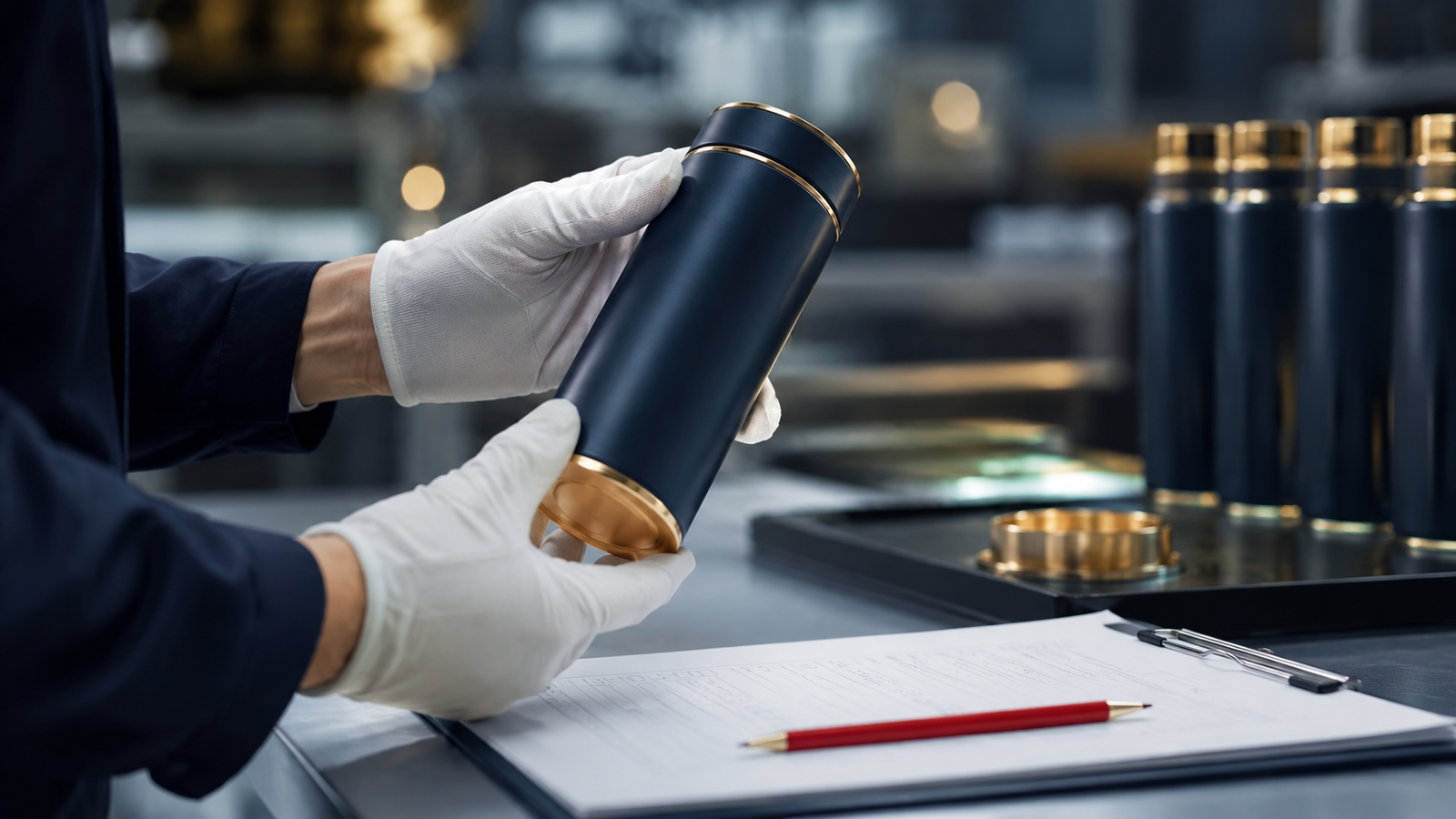
Between the moment a buyer approves an order and the moment the goods arrive, a great deal happens that most buyers never see — and it is exactly that hidden stretch that decides whether the delivery is excellent or a disappointment. This guide opens up the production and quality process for the person placing the order: procurement, marketing and operations buyers in the UAE who want to understand what they are paying for, what can go wrong, and how to protect quality on a branded or bulk order. It is a knowledge guide, not a sales page.
Understanding production is not academic. A branded product only delivers its value if it is made correctly — industry research by the Advertising Specialty Institute has repeatedly found that the vast majority of recipients keep and remember a well-made promotional item, generating thousands of brand impressions over its life. A poorly-made one is thrown away, taking your brand and your budget with it. Quality is the difference.
The end-to-end production journey
Almost every branded or bulk order follows the same backbone. Knowing the stages lets you ask the right question at the right moment instead of discovering a problem at delivery.
- Brief & specification — product, material, colours, decoration method, quantity and deadline are agreed and written down.
- Quote & confirmation — pricing, MOQ and lead time are set; you place the order and, typically, a deposit.
- Sample / proof & artwork approval — you approve a digital proof or physical sample before mass production begins. This is your most important checkpoint.
- Production — the run is manufactured and decorated (printed, engraved, embroidered) to the approved sample.
- Quality control — output is inspected against the sample and specification before it leaves.
- Packing & delivery — goods are packed to survive transit and delivered on the agreed date.
For imported goods this journey stretches to include factory verification, shipping and customs — covered in detail in our guide to sourcing from China and Alibaba — and choosing the partner who runs this process well is the subject of how to choose a supplier.
The proof and the sample: your key checkpoint
The single most powerful thing a buyer can do to protect quality is to take approval seriously. There are two things you may be asked to sign off, and they are not the same.
- A digital proof is an on-screen mock-up showing logo placement, size, colours and layout. Check spelling, colours (against your brand), scale and position carefully — what you approve is what gets made.
- A physical sample (or pre-production sample) is the real product decorated as it will be produced. It shows true colour, feel, decoration quality and durability in a way no screen can.
For a large, important or first-time order, insist on a physical sample before mass production. Once you sign off, that approved sample becomes the standard the whole run is measured against — so approve carefully, and keep a copy. Vague approval is how the wrong shade of blue ends up on ten thousand units.
Understanding MOQ and why it exists
Minimum order quantity (MOQ) frustrates first-time buyers, but it is not arbitrary. Setting up a print screen, an embroidery file, an engraving jig or a production line carries a fixed cost that is the same whether you make 20 units or 2,000. Spreading that setup over more units is what makes each unit cheaper — which is why unit price falls as quantity rises. MOQs exist so a supplier can cover setup and still offer a sensible price. Where an MOQ is a barrier, options include choosing a stocked product, a simpler decoration method, or negotiating — all covered in our sourcing guide.
Realistic production lead times
‘How long will it take?’ has no single answer, because lead time depends on the product, the decoration method, the quantity and whether goods are stocked or made to order. The table gives realistic planning guidance for locally-decorated orders; imported or fully-custom items take longer.
| Order type | Typical planning window | Drivers |
|---|---|---|
| Stocked product, simple branding | A few days to about a week | Product on hand; only decoration and QC needed |
| Made-to-order local decoration (print/embroidery/engraving) | About 1–3 weeks | Setup, production run size, decoration complexity |
| Custom-produced or imported goods | Several weeks or more | Sampling, production, freight, customs — see the sourcing guide |
| Complex multi-item or large programme | Plan well ahead | Multiple SKUs, approvals and coordination |
The golden rule: build your timeline backwards from the date you need the goods, add the artwork-approval time (which depends on you as much as the supplier), and always keep a buffer before an event, launch or handover. Rushing production is where quality quietly slips. The decoration method itself affects the timeline — see the branding and printing methods guide.
What quality control actually looks like
Quality control is not one final glance before shipping; on a well-run order it happens at three points.
- Pre-production — checking materials and the approved sample before the run starts, so errors are caught before they multiply.
- In-line (during production) — spot-checking output as it is made to catch drift in colour, registration or stitch quality early.
- Pre-shipment — inspecting the finished goods against the sample and specification, checking a representative sample of the batch for defects, colour, decoration accuracy and count, before anything is packed and dispatched.
On large orders, inspectors check a representative sample rather than every single unit, using an accept/reject approach to judge the batch — the principle behind formal AQL (Acceptable Quality Level) sampling. As a buyer you do not need to run this yourself; you need to confirm your supplier does, and to ask for photos or an inspection report on a big run.
Colour accuracy and consistency
Colour is the most common quality complaint and the most avoidable. Screens, materials and decoration methods all render colour differently, so ‘blue’ is not a specification. Specify brand colours as Pantone references, approve colour on a physical sample where it matters, and ask your supplier to record the batch so re-orders match. Setting this expectation up front prevents the single most frequent post-delivery dispute.
Sustainable materials, briefly
Quality and responsibility increasingly go together. Buyers are choosing recycled, natural and responsibly-sourced materials — the reasoning behind why jute and cotton make strong sustainable choices applies across branded products. Ask your supplier what sustainable options exist for your item; a good one will have genuine answers rather than vague claims.
Common production pitfalls — and how to avoid them
- Approving on a screen proof only, then being surprised by the physical result — always sample a big or important order.
- Leaving no buffer, forcing a rushed run where quality slips — plan backwards from the deadline.
- Specifying colour by name instead of Pantone — leads to mismatches across batches and materials.
- Not confirming who inspects and when — ask for the QC approach and a report on large runs.
- Judging suppliers on price alone — the cheapest quote that fails QC is the most expensive order. Use a structured approach; see how to choose a supplier and how to choose the best corporate gifts.
How to write a spec that prevents problems
Most production problems are really specification problems — gaps the buyer left that the factory filled with a guess. A tight, written brief is the cheapest quality tool you have. A good branded-product specification records all of the following, unambiguously.
- Product & material — exactly what item, in what material, weight or grade.
- Decoration — method, position(s), size and the number of colours.
- Colour — Pantone references for every brand colour, not colour names.
- Quantity & breakdown — totals and any split by size, colour or variant.
- Packaging — how items should be packed, individually or bulk, and any labelling.
- Deadline & delivery — the required in-hand date and the delivery location.
Put it in writing, have the supplier confirm it back, and attach the approved sample. What is written and approved is what you can hold the supplier to — anything left vague is a risk you have chosen to carry. Choosing a partner who documents this well is covered in how to choose a supplier.
Packaging and protecting goods in transit
Perfect production can still arrive damaged if packing is an afterthought. Packaging does two jobs: it protects the goods, and — for gifts and premium items — it is part of the product experience. Agree how items are packed (individually poly-bagged, boxed, bulk-cartoned), whether presentation packaging is required, and how cartons are labelled for a multi-location delivery. For fragile items such as awards, glassware or electronics, insist on protective inner packaging. For imported shipments, packing also has to survive weeks of freight handling — a point covered in our sourcing guide.
Documentation you should keep
Good records turn a dispute into a quick resolution. Keep the written specification, the approved digital proof and physical sample (or clear photos of it), the purchase order and quote, any inspection report or QC photos, and a proper VAT invoice with the correct details. On a large or repeat programme this paperwork is also what lets you re-order accurately and hold consistent quality across time. It costs nothing to file and saves a great deal if something goes wrong.
If a delivery has a defect
Even with good process, occasional issues happen; how they are handled is the real test of a supplier. Act promptly and objectively.
- Inspect on arrival and document any issue immediately with photos, before the goods are used or distributed.
- Compare against the approved sample and written spec — the objective standard you both agreed — rather than a subjective impression.
- Raise it clearly and early with specifics: what is wrong, on how many units, against which agreed point.
- A good supplier will make it right — rework, replace or credit; how they respond tells you whether to keep working with them, as discussed in how to choose a supplier.
What to actually check on a sample
Approving a sample is only useful if you know what to look at. Treat the sample as a checklist, not a formality, and inspect it deliberately against your specification.
- Decoration accuracy — is the logo the right size, in the right position, with the right number of colours and no distortion?
- Colour — does it match your Pantone reference on the actual material, in daylight, not just on screen?
- Spelling and detail — check every character of any text; a typo approved on a sample becomes a typo on the whole run.
- Material and build quality — does the product feel as specified; are seams, fittings, edges and finish sound?
- Durability — where relevant, test it: rub the print, wash the garment, handle the item as the end user will.
Record your approval clearly and keep the signed-off sample. It is now the reference the production run and pre-shipment inspection are both judged against.
In-house production versus an importer
Who actually makes your order shapes how much control you have over quality and timeline. A supplier with in-house production — printing, engraving and embroidery under one roof — can control quality directly, react quickly to changes, and turn around local decoration fast, which matters for quality-critical and time-sensitive orders. An importer or trading company offers breadth and can be right for large, standardised or unusual items, but adds distance between you and the factory and lengthens the timeline. Neither is universally better; match the route to the job, and understand which you are dealing with. The full comparison sits in how to choose a supplier, and the import route is detailed in our sourcing guide.
Compliance, safety and responsible production
For certain products, quality includes safety and compliance, not just appearance. Items intended for children, food-contact drinkware, electronics and PPE may need to meet specific standards or carry particular markings, and reputable producers can evidence this. Responsible production also means materials sourced ethically and, increasingly, sustainably — the reasoning behind why jute and cotton are strong sustainable choices applies broadly. If your order touches any regulated category, raise it explicitly at the specification stage and ask your supplier what compliance evidence they can provide — confirm current requirements for your product category before ordering, as standards change (needs confirmation).
Talk to a UAE production specialist
Mustang Advertising runs in-house production in Dubai — printing, engraving and embroidery under one roof — with quality control built into every job since 2007. Learn about the group on our companies page or contact the team to discuss a project. To browse products and request a quote, visit our B2B catalogue at giftsuppliers.ae. Lead magnet referenced below is planned and not yet built — needs build. A downloadable Pre-Production QC Checklist is planned to help you protect quality on every order.
Frequently asked questions
Why is there a minimum order quantity? Setup costs — screens, embroidery files, jigs, machine setup — are fixed regardless of quantity. An MOQ spreads that cost so each unit is priced sensibly; unit price falls as quantity rises.
Should I ask for a sample before a big order? Yes. For any large, important or first-time order, approve a physical pre-production sample. It becomes the standard the whole run is measured against and prevents costly surprises.
How long does a branded order take to produce? A stocked product with simple branding can take days; made-to-order local decoration typically 1–3 weeks; custom or imported goods several weeks or more. Always plan backwards from your deadline with a buffer.
How do I make sure the colours are correct? Specify brand colours as Pantone references, approve colour on a physical sample where it matters, and ask the supplier to record the batch so re-orders match.
What does quality control involve? On a well-run order, checks happen pre-production, during production and pre-shipment, with a representative sample of the batch inspected against the approved sample and specification before dispatch.
What is AQL in quality control? AQL (Acceptable Quality Level) is a standard sampling approach: an inspector checks a representative sample of a batch and applies an accept/reject threshold, so large runs can be judged reliably without inspecting every single unit.
How do I protect a fragile order such as awards or glassware? Specify protective inner packaging and sturdy outer cartons at the order stage, and for imported goods ensure packing is built to survive weeks of freight handling, not just a short local delivery.
What should I do if part of my order arrives faulty? Inspect and photograph on arrival before use, compare against the approved sample and written spec, and raise it promptly with specifics. A reputable supplier will rework, replace or credit the affected units.
Why do the same colours look different on different products? Materials and decoration methods absorb and reflect colour differently, so one Pantone can look slightly different on cotton, polyester, metal or plastic. Approving colour on a physical sample of the actual product prevents this becoming a surprise.
