
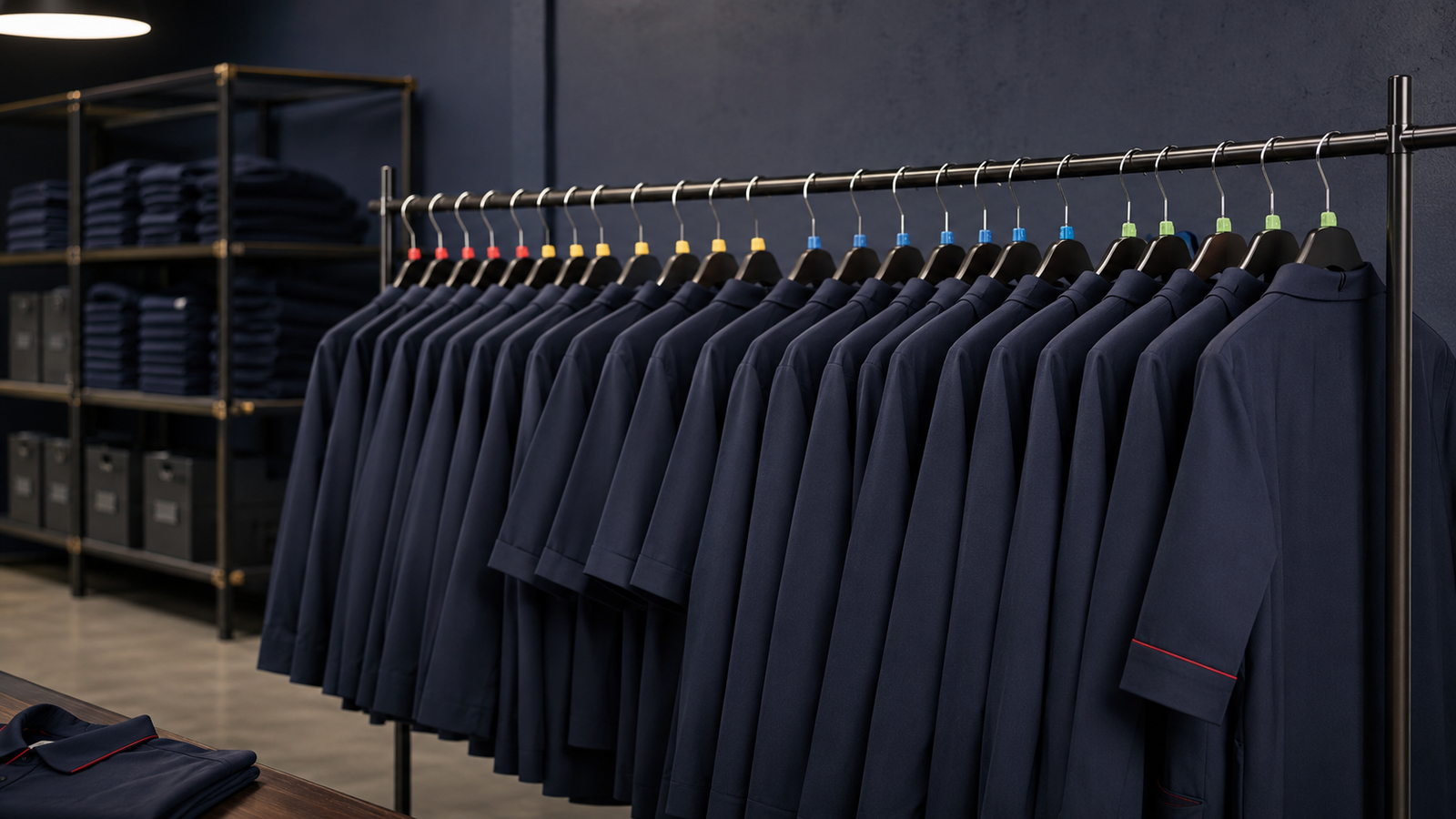
A smooth uniform sizing and rollout process is what turns a uniform order from a logistical headache into a non-event — every staff member gets the right size, on time, with minimal returns and reorders. Getting sizing and distribution right across a team is where many uniform projects stumble: order too tight and you face returns and unhappy staff; order without a system and you drown in admin. This guide gives you a repeatable process for sizing, ordering and rolling out uniforms across a UAE workforce.
Why uniform sizing and rollout needs a system
Uniforms are worn by a diverse workforce with a wide range of body shapes, and UAE teams are often multinational, which widens the size range further. Guessing sizes leads to returns, wasted stock and staff who avoid wearing ill-fitting kit — undermining the whole point of a uniform. A structured sizing and rollout process removes the guesswork, controls cost and gets your team properly kitted with minimal disruption.
Step 1 — Run a sizing exercise
Never order blind from a headcount. The reliable approach is a physical size set: order sample garments in every size, let staff try them on, and record each person’s confirmed size. This upfront step dramatically cuts returns later.
- Order a size set — one garment per size in the chosen style and fabric.
- Hold a fitting session — staff try on and confirm their size in person.
- Record sizes centrally — a simple sheet mapping each employee to a confirmed size.
- Account for fit preference — some prefer a looser fit; note it during fitting.
- Add a small buffer stock — spare units in common sizes for new joiners and replacements.
A physical fitting matters because sizing is not standardised across manufacturers — a ‘large’ in one brand is a ‘medium’ in another. Confirming against the actual garment you will produce is the only reliable method, and our quality and production guide explains why pre-production samples protect the whole order.
Step 2 — Plan quantities and reordering
Once sizes are confirmed, decide how many garments per person and how you will handle ongoing needs. Most roles need multiple sets so staff always have a clean uniform; front-of-house and industrial roles often need more.
| Item | Typical per person | Notes |
|---|---|---|
| Daily-wear shirt / polo | 3–5 sets | Enough to cover the laundry cycle |
| Outerwear / jacket | 1–2 | Seasonal or role-dependent |
| Buffer stock (common sizes) | 5–10% of order | For new joiners and replacements |
| Reorder trigger | At buffer low point | Keep artwork on file for fast reorders |
Holding buffer stock and keeping your logo digitised or screens on file means new joiners are kitted within days rather than waiting for a full production run. This is the single biggest driver of a low-friction ongoing uniform programme.
Step 3 — Roll out and distribute
Plan the handover as carefully as the order. Label garments by employee where possible, distribute by department or shift to avoid chaos, and set a clear ‘go-live’ date for the new uniform. Communicate wash-care instructions so the investment lasts. For multi-site operations, ship pre-sorted boxes per location. A little coordination here prevents the classic rollout-day scramble.
For garment styles and bases to build your uniform programme on, browse the apparel and accessories range and headwear options. Our customised uniform manufacturing guide and uniform branding guide cover how the garments are produced and decorated in-house.
Building an ongoing uniform programme
A uniform order is not a one-time event — it is the start of an ongoing programme, and treating it that way from the beginning saves significant admin later. Staff turnover, damaged garments and growth all generate a steady stream of replacement and new-joiner needs. The businesses that handle this smoothly set up a simple system once: a central sizing record, a modest buffer stock in common sizes, branding files kept on hand for fast reorders, and a single owner (usually HR or office management) responsible for monitoring stock and triggering reorders before you run low. With this in place, kitting a new employee becomes a same-week task rather than a mini-project each time.
For larger or multi-site operations, agreeing a standing arrangement with your producer — who holds your branded stock and fulfils reorders on demand — removes the last piece of friction entirely. You place an initial batch, the producer holds buffer stock and your artwork, and you simply request garments as needed. This converts uniform management from a recurring headache into a predictable, low-effort service, and keeps every team member properly presented no matter how quickly you hire.
Common uniform rollout mistakes to avoid
A few recurring errors cause most uniform-project frustration, and all are avoidable with a little planning.
- Ordering by headcount without a fitting — the top cause of returns and ill-fitting kit.
- No buffer stock — leaving new joiners waiting for a full production run.
- Losing branding files — forcing repeat digitising or setup on every reorder.
- Too few sets per person — staff caught without a clean uniform mid-cycle.
- No clear go-live date — a messy transition where old and new uniforms mix.
- Skipping wash-care communication — premature fading and shrinkage from incorrect laundering.
Avoiding these keeps a uniform programme cheap to run and consistently smart in appearance. The upfront discipline of a fitting session, a central record and a buffer stock pays back many times over across the life of the programme, turning what is often a stressful, error-prone exercise into a quiet, reliable system that scales with your team.
A simple uniform rollout timeline
Mapping the rollout against a clear timeline keeps everyone aligned and prevents the last-minute rush that derails many uniform projects. While exact durations depend on quantity and complexity, the sequence below is a reliable template for a UAE team uniform rollout.
| Stage | Activity | Owner |
|---|---|---|
| Week 1 | Confirm styles, fabric and branding; request size set | HR / office manager |
| Week 2 | Fitting session; record confirmed sizes centrally | HR + staff |
| Week 3 | Approve artwork and pre-production sample; place order | HR + producer |
| Weeks 4–5 | Production, branding and quality control | Producer |
| Week 6 | Delivery, sorting and distribution; go-live | HR / office manager |
Building in a pre-production sample and a fitting session may feel like extra steps, but they are precisely what prevents the expensive problems — wrong sizes, off-brand branding, or a fabric that disappoints — that turn a straightforward order into a costly redo. Treat the first rollout as setting up a repeatable system: once your sizes, artwork and buffer stock are established, every subsequent cycle is far faster and simpler. A well-run uniform programme quietly reinforces your brand every single day your team is at work, which makes the modest effort of getting the process right one of the better-value investments a growing UAE business can make. Get the system right once, keep your records and buffer stock current, and your uniform programme will run smoothly and look consistently sharp for years, supporting your brand at every customer touchpoint without demanding constant attention from your team, freeing you to focus on running the business rather than managing uniform logistics batch after batch as your headcount changes.
Frequently asked questions
How do I get uniform sizes right for a team?
Run a physical sizing exercise: order a size set with one garment per size, hold a fitting session so staff confirm their size in person, and record sizes centrally. This is far more reliable than guessing from a headcount.
How many uniform sets does each employee need?
Most roles need 3–5 daily-wear sets so staff always have a clean uniform through the laundry cycle, plus outerwear where relevant. Industrial and front-of-house roles often need more.
Why not just order by headcount?
Sizing is not standardised across manufacturers, so ordering blind leads to returns, wasted stock and ill-fitting uniforms. A fitting session against the actual garment you will produce avoids costly mistakes.
How do I handle uniforms for new joiners?
Hold a small buffer stock (around 5–10% of the order) in common sizes and keep your artwork on file. New joiners can then be kitted within days instead of waiting for a full production run.
Should I keep spare uniform stock?
Yes. A modest buffer of common sizes covers new joiners, replacements and damaged garments, keeping your team properly presented without a fresh production run each time.
How do I distribute uniforms across multiple sites?
Ship pre-sorted boxes per location, label garments by employee where possible, and set a clear go-live date. Distributing by department or shift keeps rollout day orderly.
How can I make reordering uniforms faster?
Keep sizing records, buffer stock and branding files (digitised logo or screens) on hand. With these in place, reorders skip setup and fitting and can be produced quickly and consistently.
Talk to our team — free consultation
Call or WhatsApp one of our team members now for a free consultation:
- Ms Bonita — +971 55 432 6712
- Mr Jaleel — +971 55 959 9806
- Mr Shoaib — +971 55 265 8802
- Email — [email protected]