
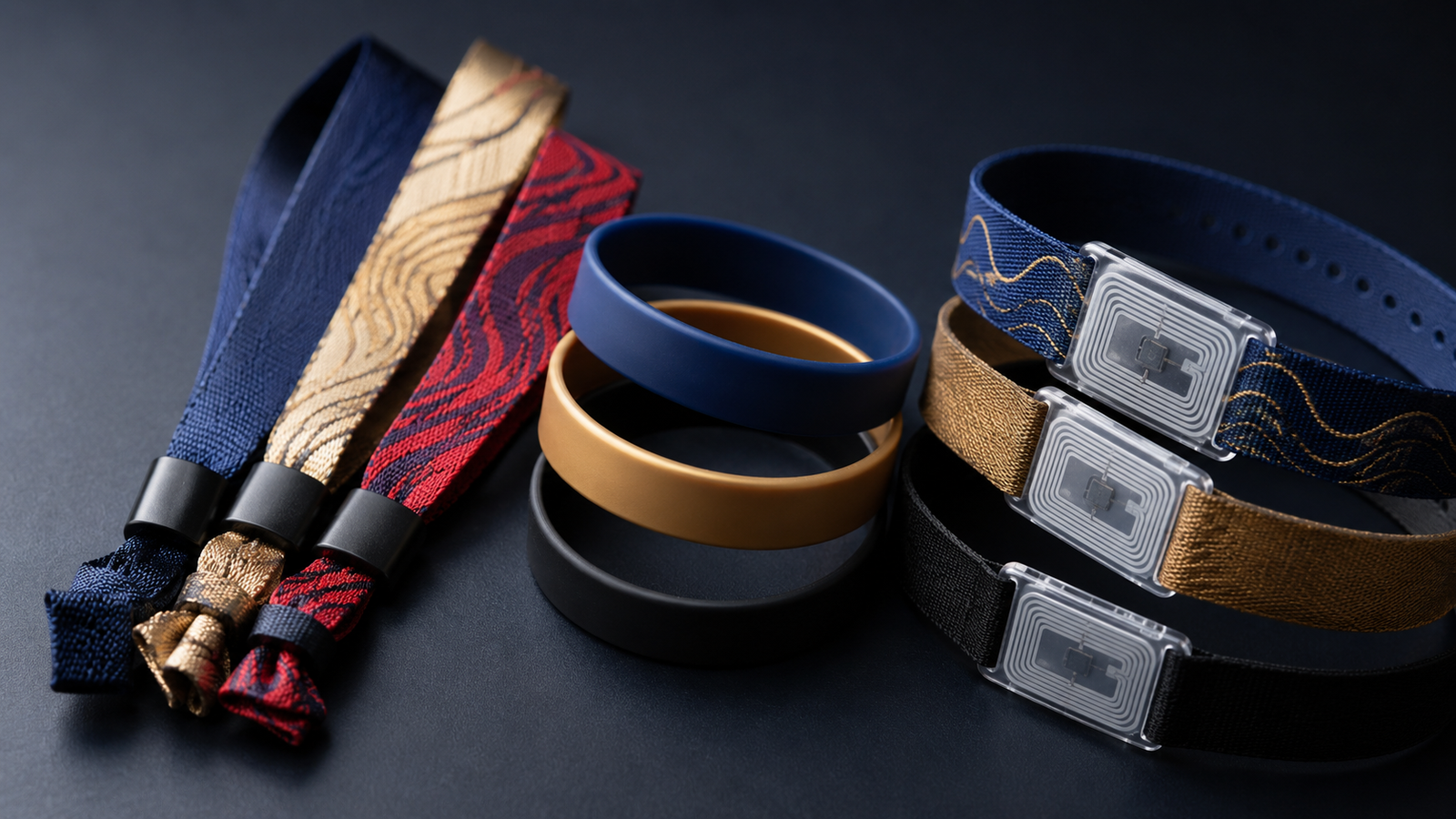
Getting event wristbands and access control right is what keeps an event secure, organised and smooth to run — controlling who gets in, tracking attendance, and even enabling cashless payments. From festivals to conferences to controlled-access zones, wristbands are the workhorse of event access in the UAE. This guide explains the main wristband types, when to use each, and how RFID adds smart functionality far beyond simple entry.
Why event wristbands and access control matter
Wristbands are the simplest, most visible way to manage entry at scale. Worn and hard to transfer, they let staff verify access at a glance, separate ticket tiers or zones by colour, and resist the fraud that paper tickets invite. For any event with controlled entry, tiered access, or a need to track attendance, a wristband system is faster and more secure than checking tickets at every point, and it scales smoothly from a small conference to a large festival.
The main wristband types
Wristbands range from simple disposable bands to smart RFID-enabled ones. The right choice depends on the event’s duration, security needs and whether you need smart functions like cashless payment.
| Type | Best for | Key benefit |
|---|---|---|
| Tyvek (paper) | Single-day events, high volume | Cheapest; tamper-evident; disposable |
| Vinyl / plastic | Multi-day events | Durable; waterproof; reusable colours |
| Fabric / woven | Festivals, premium events | Comfortable; premium look; hard to remove |
| Silicone | Reusable, promotional | Durable; branded keepsake |
| RFID-enabled | Smart access, cashless, tracking | Entry control, payments, data |
For a single-day event with high volume, Tyvek is the cheap, tamper-evident default. For multi-day events, vinyl or fabric bands last and resist water. For festivals and premium events, woven fabric bands look and feel better. Browse custom wristbands and RFID silicone wristbands for options.
How RFID wristbands add smart control
RFID (radio-frequency identification) wristbands carry a chip that turns the band into a smart credential. Tapped at a reader, they enable fast contactless entry, tiered zone access, attendance tracking, and cashless payment at bars and stalls — all while reducing queues and fraud. For larger or recurring events, the data and speed RFID provides often justify the higher per-band cost. Our event merchandise and wristbands guide covers how these integrate into event operations, and the event supplies range lists related equipment.
- Fast entry — tap-to-enter cuts queues at the gate.
- Zone control — grant access to specific areas by ticket tier.
- Cashless payment — top up and pay at stalls without cash.
- Attendance data — track flow and numbers in real time.
- Fraud resistance — chips are far harder to copy than paper.
Choosing the right wristband for your event
The decision comes down to matching the wristband to the event’s duration, budget, security needs and desired experience. Start with duration: single-day events rarely justify anything beyond Tyvek, while multi-day events need durable vinyl or fabric that survives showering, sleeping and repeated scanning. Then consider security: high-value or tiered-access events benefit from harder-to-transfer fabric or RFID bands, while low-risk events can use simpler colour-coded bands. Budget naturally influences the choice, but it is worth weighing the full picture — RFID bands cost more per unit but can reduce staffing at entry points, cut queues, capture valuable attendance data and enable cashless revenue, which for larger events can more than offset the extra cost. Finally, think about the attendee experience and branding: fabric and silicone bands double as comfortable, keepable branded souvenirs, extending your event’s presence long after it ends.
For recurring events, standardising on a wristband system and keeping your branding on file makes each edition faster to organise and visually consistent. Colour-coding by year or tier, combined with a reliable supplier who can produce to deadline, turns access control from a yearly scramble into a repeatable process. Our quality and production guide explains how to specify and proof wristbands before a full run, ensuring colours, print and sizing are right before the order is produced at volume.
Planning wristband quantities and logistics
Order wristbands with a clear buffer above expected attendance — running out at the gate is far more damaging than a modest overspend, and last-minute reorders rarely arrive in time. Account for staff, VIPs, media and contractors as separate tiers, ideally colour-coded, so access is clear at a glance. For RFID events, allow time before the event to encode and test the bands, and to brief gate staff on the readers and process. Plan distribution too: how bands reach attendees (posted in advance, collected at registration, or applied on entry) affects both the type you choose and the staffing you need on the day. A little logistical planning here prevents the most common event-day access problems — queues, confusion over tiers, and shortages — and keeps entry smooth and secure from the first arrival to the last.
Branding your event wristbands
Beyond access control, wristbands are a branding surface worn by every attendee for the entire event, which makes them valuable real estate. Event names, sponsor logos, colours and even patterns can be printed onto most band types, turning a functional item into a walking advertisement and, for fabric and silicone bands, a keepable souvenir. Sponsors often pay for logo placement on wristbands precisely because of this constant visibility, which can offset the cost of the bands entirely. When specifying, decide early whether the band needs to carry sponsor branding, tier colours, or both, and confirm the print method suits the material — woven fabric, printed silicone and printed vinyl each reproduce branding differently. A well-branded wristband reinforces the event identity every time an attendee glances at their wrist, and the best examples become mementoes that keep the event alive in memory long after it ends. As with all branded production, approve a proof before the full run so colours and logos are exactly right, and keep the artwork on file for recurring events so each edition is fast to reorder and visually consistent with the last.
Wristband logistics on event day
Even the best wristband system fails if event-day logistics are not planned. Decide how bands are applied — self-applied on entry, fitted by staff, or pre-issued at registration — as each affects staffing and queue flow. For RFID events, encode and test every band before the doors open, and have a fallback process ready in case a reader fails, so a technical glitch never stops entry. Brief gate staff thoroughly on the tiers, colours and reader process, and position enough people at peak entry times to keep queues moving. Keep spare bands in every tier at the gate for replacements and unexpected arrivals. For multi-day events, plan how re-entry works and whether bands need daily validation. These operational details are what turn a well-chosen wristband into a smooth, secure entry experience, and getting them right is as important as the band itself — the smartest RFID system is worthless if attendees are stuck in a slow queue because the process was not rehearsed. A short walkthrough of the entry process with all gate staff the day before, covering each tier and the reader workflow, is the cheapest insurance available against event-day access chaos, and it gives staff the confidence to handle problems calmly rather than freezing at the gate.
Frequently asked questions
What are the main types of event wristbands?
The main types are Tyvek (paper) for single-day high-volume events, vinyl or fabric for multi-day events, silicone for reusable promotional bands, and RFID-enabled bands for smart access, cashless payment and tracking.
What is an RFID wristband?
An RFID wristband contains a chip that acts as a smart credential. Tapped at a reader, it enables contactless entry, zone access control, attendance tracking and cashless payment, reducing queues and fraud at events.
Which wristband is best for a single-day event?
Tyvek (paper) wristbands are the usual choice for single-day, high-volume events. They are the cheapest option, tamper-evident and disposable, making them ideal where cost and speed matter most.
Are RFID wristbands worth the extra cost?
For larger or recurring events, often yes. The faster entry, zone control, cashless payment and attendance data RFID provides can justify the higher per-band cost by improving operations and revenue capture.
Can wristbands control access to different zones?
Yes. Colour-coded bands separate ticket tiers or zones visually, while RFID bands can be programmed to grant or deny access to specific areas electronically at each reader point.
Are event wristbands secure against fraud?
Wristbands are worn and hard to transfer, making them more secure than paper tickets. Tamper-evident Tyvek resists reuse, and RFID chips are far harder to copy, offering the strongest fraud resistance.
How many wristbands should I order?
Order a clear buffer above expected attendance, and account for staff, VIPs, media and contractors as separate colour-coded tiers. Running out at the gate is far more damaging than a modest overspend.
Talk to our team — free consultation
Call or WhatsApp one of our team members now for a free consultation:
- Ms Bonita — +971 55 432 6712
- Mr Jaleel — +971 55 959 9806
- Mr Shoaib — +971 55 265 8802
- Email — [email protected]