
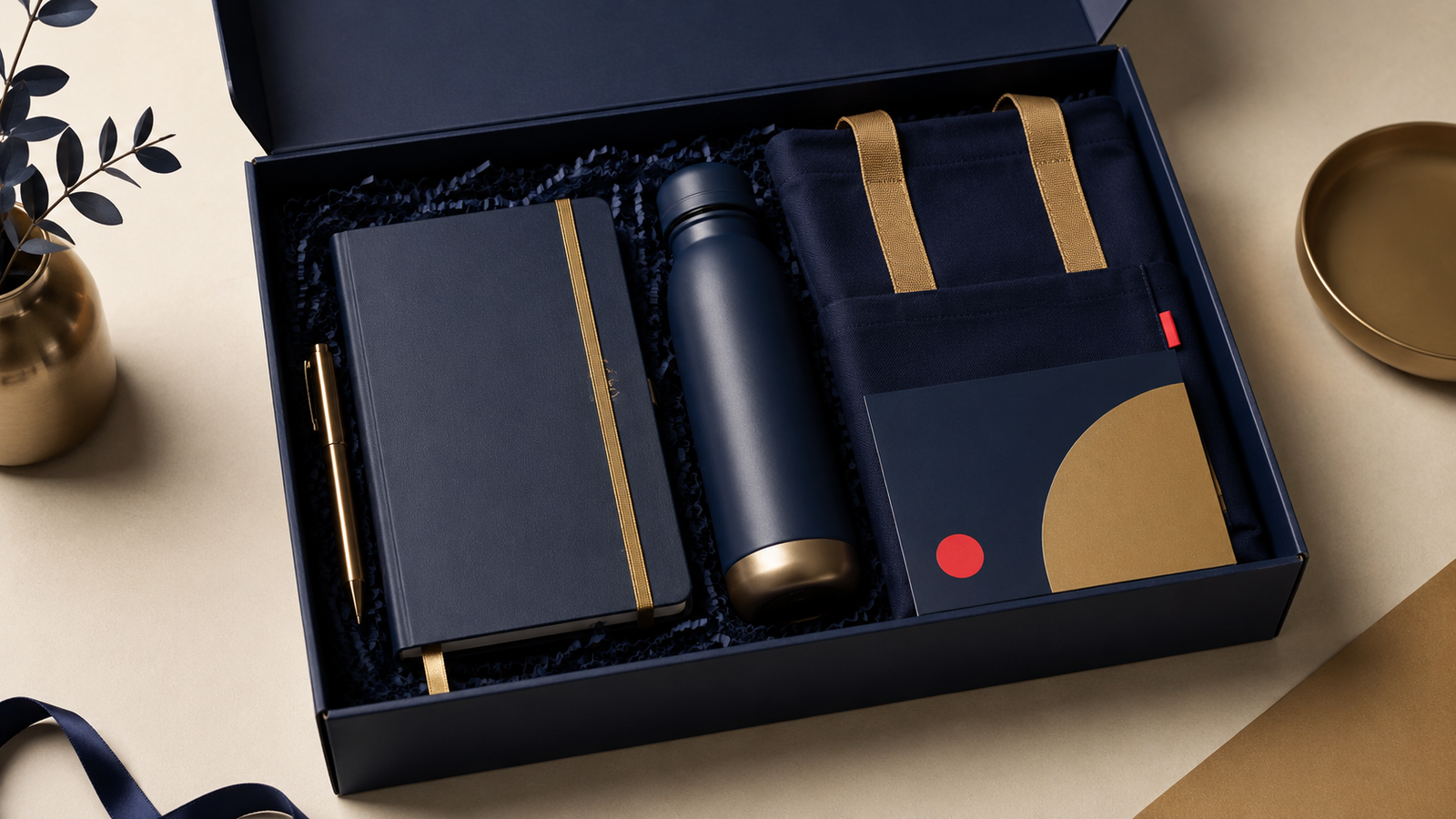
A well-designed employee welcome kit turns a new hire’s first day from an admin formality into a moment that signals ‘you made the right choice’. In the UAE’s competitive hiring market, onboarding gifts and branded welcome packs are a low-cost, high-impact way to build belonging, reinforce culture and get company kit into people’s hands from day one. This guide covers what to include, how to tier kits by role, and how to order them so they arrive before the new starter does.
Why employee welcome kits work
First impressions compound. A thoughtful welcome kit reduces first-day friction, makes remote and hybrid starters feel included, and quietly reinforces brand identity every time the recipient uses the item. For growing UAE teams, a repeatable onboarding kit also saves HR time — one approved pack, reordered on demand, instead of scrambling per hire.
What to include in an employee welcome kit
Build the kit in layers: the practical essentials everyone needs, a few brand-building items, and an optional premium touch for senior or client-facing roles.
- Everyday essentials — branded notebook, quality pen, and a reusable bottle or mug people actually use daily.
- Tech — branded power bank, cable set or wireless charger from the technology and accessories range.
- Carry — a laptop bag, backpack or tote from bags and travel to hold the kit and daily gear.
- Desk and stationery — items from branded office essentials that make the workspace feel set up.
- Apparel — a branded t-shirt, polo or cap for team identity and events.
- Welcome card and culture guide — a personal note and a short ‘how we work’ piece.
Tiering welcome kits by role
| Kit tier | For | Typical contents |
|---|---|---|
| Standard | All new hires | Notebook, pen, bottle/mug, welcome card |
| Enhanced | Skilled / hybrid roles | Standard + tech accessory + branded bag + apparel |
| Executive | Senior / client-facing | Premium notebook, quality tech, premium bag, presentation packaging |
Tiering keeps spend proportionate while ensuring every starter gets a consistent core experience. Choosing durable, genuinely useful items matters more than piling in quantity — read how to choose gifts people value for selection logic that applies equally to staff.
How to order and reorder welcome kits
The efficient model is to standardise one or two kit tiers, brand and produce a batch, then hold stock for on-demand assembly as people join. This spreads setup cost across the batch and means kits are ready before each start date. Keep artwork on file so reorders skip origination and stay consistent. For custom or co-branded pieces, explore customised gift items, and see our corporate gifts and merchandise guide for branding-method options.
Because welcome kits are reordered regularly, a reliable production partner matters — our guide to choosing a supplier and quality and production guide help you set up a repeatable, quality-controlled kit programme.
Presentation and unboxing that reinforces your brand
How the employee welcome kit arrives shapes the first impression as much as what is inside it. A branded box with tidy internal presentation turns a bundle of items into an experience, and it photographs well when new hires share it — a small but genuine boost to your employer brand on LinkedIn and internally. Keep the unboxing considered: items arranged rather than loose, a welcome card on top, and packaging that reflects your brand colours. For hybrid and remote starters, a well-packed kit that survives courier handling and arrives before day one does real work in making someone feel part of the team before they have met anyone.
Timing the kit around the onboarding journey
The best programmes think beyond day one. A staggered approach keeps engagement high across the crucial first weeks without a large extra spend, and it gives you natural moments to reinforce culture.
| Stage | Touchpoint | Typical item |
|---|---|---|
| Pre-start | Kit ships to arrive before day one | Core welcome kit + card |
| Day one | Desk set-up ready | Notebook, pen, drinkware, apparel |
| Week one | Team integration | Tech accessory or bag |
| 30–90 days | Milestone recognition | Small branded reward or extra apparel |
Building the kit as a repeatable, tiered programme rather than a one-off purchase is what makes it sustainable as you scale. Standardise the core, hold branded stock, keep artwork on file, and you can welcome one hire or fifty with the same consistent, on-brand experience — a genuine operational advantage for any growing UAE business competing for talent.
Choosing items people will actually use
The fastest way to waste a welcome-kit budget is to fill it with items that end up in a drawer. Utility is the test that matters: every piece should earn its place by being used, seen, or genuinely appreciated. A branded bottle that travels to the gym, a power bank that lives in a laptop bag, or a notebook a new hire opens in their first meeting all keep your brand in daily view. Novelty items rarely do. When budgets are tight, it is almost always better to include fewer, better items than to pad the kit with low-cost filler that signals the opposite of the care you are trying to show. Durability matters too — a cheap item that breaks in a week leaves a worse impression than not including it at all.
Welcome kits as an employer-brand tool
A welcome kit is a small investment with an outsized return on culture and retention. The first weeks shape how a new hire feels about their decision to join, and a considered kit is a tangible, repeated reminder that they are valued. For UAE businesses competing hard for skilled staff, that early signal matters. Kits also travel: new hires share unboxing moments, and a well-designed pack quietly markets your company as a good place to work. Treated as part of a broader onboarding experience rather than an afterthought, the humble welcome kit becomes one of the highest-return branded-merchandise spends a growing company can make.
Scaling welcome kits as your team grows
What works for a handful of hires needs to hold up when you are onboarding steadily or in cohorts. The operational answer is standardisation: lock down one or two approved kit tiers, produce branded components in batches to secure better pricing, and hold assembled or ready-to-assemble stock so a kit is always available at short notice. Keeping artwork and specifications on file means reorders are fast and consistent, with no repeat setup charges. Assign one owner — usually HR or office management — to monitor stock levels and trigger reorders before you run low, so a new starter is never left without a kit. This turns onboarding gifting from a recurring scramble into a quiet, reliable system that scales with headcount. For companies planning rapid growth, agreeing a standing arrangement with a single production partner who holds your branded stock and assembles kits on demand removes the last piece of friction entirely, letting you welcome new people properly no matter how fast you are hiring. The result is a repeatable onboarding experience that stays consistent from your first hire to your hundredth, protects your employer brand, and frees your team from reinventing the process every time someone joins.
Frequently asked questions
What should be in an employee welcome kit?
A practical core of branded essentials — notebook, pen, and a reusable bottle or mug — plus brand-building items like a tech accessory, bag or apparel, and a personal welcome card. Add a premium touch for senior roles.
How much should a welcome kit cost?
It depends on tier. A standard kit can be modest per head, while enhanced and executive kits cost more. Set the budget by role tier and order in batches to spread branding setup costs.
Should remote employees get welcome kits?
Yes — welcome kits are especially valuable for remote and hybrid starters, who miss the in-office first-day experience. Ship the kit to arrive before their start date.
How far ahead should I order onboarding kits?
Produce a branded batch in advance and hold stock so kits can be assembled on demand as people join. This avoids per-hire lead times and keeps kits ready before each start date.
Can welcome kits be tiered by seniority?
Yes. A common approach is a standard kit for all hires, an enhanced kit for skilled or hybrid roles, and an executive kit for senior or client-facing staff, keeping a consistent core across all tiers.
Do reorders cost less than the first order?
Usually. Branding setup is a one-off for the first run, so keeping artwork on file means reorders of the same items often skip origination charges.
What branded items are most useful in a welcome kit?
Items people use daily perform best — reusable drinkware, a quality notebook and pen, a practical bag, and a tech accessory such as a power bank or charging cable.
Talk to our team — free consultation
Call or WhatsApp one of our team members now for a free consultation:
- Ms Bonita — +971 55 432 6712
- Mr Jaleel — +971 55 959 9806
- Mr Shoaib — +971 55 265 8802
- Email — info@mustangllc.ae
