
When you ask three companies to quote the same branded order, you are often not comparing like with like at all — because one may make the product itself while another simply buys it in and adds a margin. That single difference, in-house producer versus reseller or trader, shapes your price, your lead time, your quality control and who is actually accountable when something goes wrong. This guide explains the difference, when each is the right choice, and how to tell which one you are really dealing with. It expands on our pillar guide to how to choose a supplier.
What is an in-house producer?
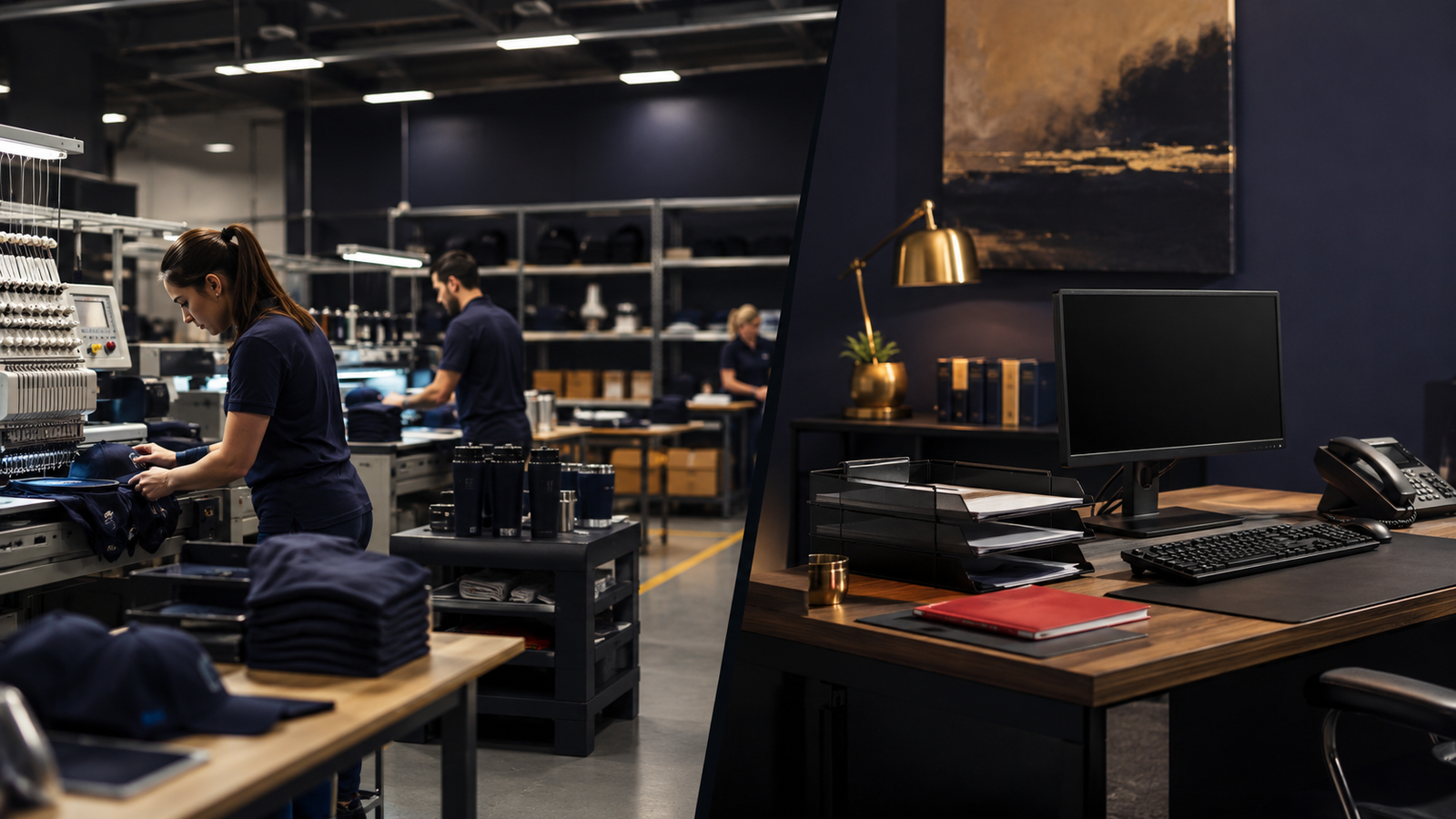
An in-house producer owns the machinery and employs the people who actually make and decorate your order — printing, engraving, embroidery and finishing under their own roof. Because production happens on their premises, they control quality directly, can react quickly to changes, and can turn local decoration around fast. Mustang Advertising is an in-house producer in Dubai, running its own print, engraving and embroidery equipment, which is why so much can be controlled and delivered from a single point.
What is a reseller or trader?
A reseller or trading company sells branded products but outsources the actual production to third parties, adding a margin for sourcing and coordinating the order. This is not inherently bad — a good trader offers enormous range and can be the right choice for standardised, high-volume or unusual items. The trade-off is distance: there is an extra link between you and the factory, which can affect quality control, speed and accountability if something needs fixing.
In-house vs reseller: the honest comparison
| Factor | In-house producer | Reseller / trader |
|---|---|---|
| Quality control | Direct — controls the machines and staff | Indirect — depends on the third-party factory |
| Speed on local decoration | Fast — no middle layer | Slower — coordinated through others |
| Range | Focused on what they produce | Very broad — can source almost anything |
| Price on their core products | Often better — no added margin | Includes a sourcing margin |
| Accountability | Owns the outcome end to end | Passes issues down the chain |
| Best for | Quality-critical, custom, time-sensitive orders | Standardised, high-volume or unusual sourced items |
When an in-house producer is the better choice
- Quality is critical — client gifts, awards and anything carrying your brand to important people.
- You are on a deadline — direct control of production means fewer handoffs and faster local decoration.
- The order is custom or complex — bespoke work benefits from talking directly to the people making it.
- You want one accountable partner — a single point that owns the result from artwork to delivery.
- You will re-order — an in-house partner keeps your artwork and specification on file for consistent repeats.
When a reseller or trader makes sense
A trader is a sensible choice when you need a very wide range, a standardised commodity item at high volume, or something unusual that no single producer makes in-house. If the product is simple and widely available and price and range matter more than tight quality control, a reputable trader can serve you well. The key word is reputable — the risks below apply most where the trader is simply a middleman with no real oversight of the factory. For imported and sourced goods specifically, our sourcing guide covers how to protect quality across that distance.
How to tell which one you are dealing with
Many suppliers are deliberately vague about this, so ask directly — a straight answer is itself a good sign.
- ‘Do you produce in-house or source this?’ — a confident, specific answer signals transparency.
- Ask about their equipment — an in-house producer can describe the machines and processes they own.
- Ask to visit or see the production area — real producers can show it; pure traders cannot.
- Check turnaround claims — very fast local decoration usually means in-house capability.
- Look at how they handle a problem — in-house partners fix it directly; traders must go back down the chain.
The hybrid reality
In practice, many strong suppliers are both: they produce their core range in-house and source complementary items they do not make, so you get the best of each. That is a healthy model — the point is not to avoid anyone who sources anything, but to understand where the real production control sits for your order, and to make sure quality-critical work is genuinely controlled rather than quietly passed to an unknown third party. A good partner is open about which parts they make and which they source.
What it means for your order
Match the route to the job. For anything that reflects your brand to clients or leadership — gifts, awards, premium items — favour genuine in-house control and a single accountable partner. For commodity items at volume, a reputable trader can be efficient. And whichever you choose, the quality-protection principles are the same: clear specification, an approved sample, and defined quality control, all covered in our quality and production guide.
Does in-house always cost more?
It is a common assumption that in-house production is more expensive, but the opposite is often true on a producer’s core range. A reseller adds a sourcing margin on top of the factory price; an in-house producer making the item themselves has no such middle margin, so their price on what they actually produce can be lower as well as better controlled. Where in-house can cost more is on items outside their core capability that they have to source anyway — in which case a specialist trader may be more efficient. The practical takeaway: for a producer’s core products, in-house is frequently both the better-quality and the better-value route, so it is always worth asking whether the item is one they make themselves.
Questions to ask before you commit
A few direct questions quickly reveal how much control a supplier really has over your order — and how honest they are about it.
- ‘Is this item made in your own facility or sourced?’ — the single most useful question.
- ‘Who handles quality control, and at what stages?’ — in-house producers answer specifically.
- ‘Can I approve a sample before production?’ — direct producers usually say yes readily.
- ‘What is your realistic turnaround for this?’ — fast, credible local timelines suggest in-house capability.
- ‘If something is wrong, how is it fixed?’ — listen for direct ownership versus ‘we’ll check with the factory’.
The point is not to catch anyone out, but to understand who is really accountable for your order — the foundation of the whole decision, as set out in our pillar guide to how to choose a supplier.
Talk to an in-house producer in Dubai
Mustang Advertising has produced branded merchandise, gifts, awards and print in-house in Dubai since 2007. Learn about the group on our companies page, contact the team to discuss your order, or browse and request a quote at giftsuppliers.ae. For the full framework on selecting a partner, start with our pillar guide to how to choose a supplier.
Frequently asked questions
What is the difference between an in-house producer and a reseller? An in-house producer owns the machinery and makes and decorates your order directly; a reseller or trader buys it in from third-party factories and adds a margin. The difference affects quality control, speed and accountability.
Is an in-house producer always better? Not always. In-house is best for quality-critical, custom and time-sensitive orders; a reputable trader can be a good choice for standardised, high-volume or unusual sourced items.
How do I know if a supplier produces in-house? Ask directly whether they produce or source, ask about their equipment, and ask to see the production area. Real producers answer specifically and can show their facility.
Can a supplier be both? Yes — many produce their core range in-house and source complementary items. That is healthy, as long as they are open about which parts they make and quality-critical work is genuinely controlled.
Why does it matter who makes my order? Because it determines who is accountable if something goes wrong, how fast changes can be made, and how tightly quality is controlled — especially on brand-critical items.
Does Mustang produce in-house? Yes — Mustang runs its own printing, engraving and embroidery in Dubai, and also sources complementary items, and is transparent about which is which for your order.
Do resellers cost more than in-house producers? On a producer’s core range, in-house is often cheaper because there is no added sourcing margin. Resellers can be competitive on standardised or unusual items they specialise in sourcing.
Can I visit a supplier’s production? A genuine in-house producer can show you their facility or production area. Inability or unwillingness to do so may indicate the work is actually sourced elsewhere.
Which is better for corporate gifts and awards? For brand-critical items like client gifts and awards, an in-house producer with direct quality control and a single point of accountability is usually the safer choice over a middleman.
Does Mustang source items it does not make? Yes — Mustang produces its core range in-house in Dubai and sources complementary items, and is clear about which is which so you always know how your order is being fulfilled.
