
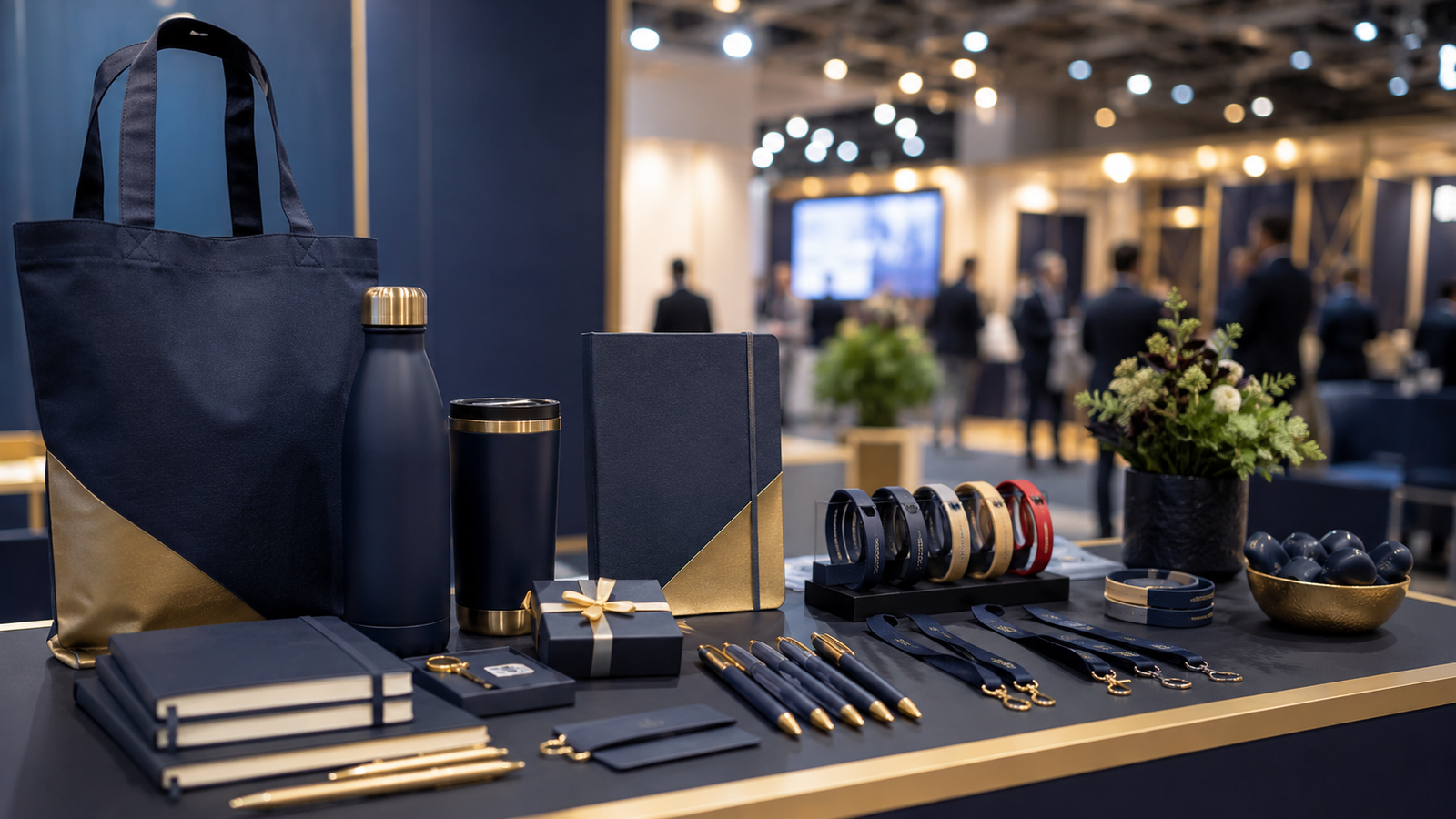
At an exhibition or event, your merchandise is doing marketing work long after the stand comes down — or it is landing in a bin on the way out. The difference is planning. This guide is written for the person responsible for event and exhibition supply in the UAE: marketing, events and operations buyers who need to choose giveaways people actually keep, get wristbands and access control right, and brief a stand correctly. It is a knowledge guide, not a sales page.
The UAE runs some of the region’s largest exhibitions — GITEX, Gulfood, Arab Health, the Dubai Airshow and many more — and competition for attention on a show floor is intense. Research by the Advertising Specialty Institute consistently shows that useful promotional items are kept and remembered by the large majority of recipients, generating brand impressions for months. At an event, the goal is simple: be the giveaway that goes home, not the one that gets left behind.
Event merchandise that gets kept
The test for any giveaway is one question: will the recipient still have this in a month? Useful, good-quality, relevant items pass; cheap novelties fail. Prioritise usefulness over gimmicks.
- Genuinely useful — items people reach for daily (drinkware, tech accessories, quality bags, notebooks, pens) stay in circulation and keep advertising.
- Right quality for the audience — a decision-maker giveaway can be a notch higher than a mass floor giveaway; segment if budget allows.
- On-brand and on-message — the item should suit the brand and, ideally, the event’s theme.
- Practical to hand out and carry — lightweight, packable items travel home; bulky ones get abandoned at the venue.
- Tiered — a keep-worthy premium item for qualified leads, a cost-effective giveaway for volume.
For inspiration on the stand itself, our note on trends in exhibition booth design is a useful companion to the giveaways that go on it.
Wristbands — types and when to use each
Wristbands are the workhorses of event access and identity, and choosing the wrong type causes real problems on the day — from queues to security gaps. Match the band to the job.
| Type | Best for | Notes |
|---|---|---|
| Tyvek (paper-like) | Single-day events, high volume, low cost | Cheap, disposable, tamper-evident; not reusable |
| Fabric / woven | Multi-day festivals and premium events | Comfortable, durable, hard to counterfeit; keep-worthy |
| Silicone | Awareness campaigns, causes, youth events | Reusable, brandable, low cost at volume |
| Vinyl / plastic | Water parks, medium-duration access | Water-resistant and durable for several days |
| RFID / NFC | Cashless payment, access control, data capture | Enables entry, payments and analytics; higher cost, higher capability |
The big decision is usually cost-and-volume versus capability-and-experience: Tyvek for a cheap, single-day crowd; fabric for a premium multi-day feel; RFID when you need cashless payments, controlled access or attendee data. Decide what the wristband must do before choosing the material.
Access control and event planning
Wristbands and credentials are part of a wider access-control plan. Think it through before ordering: how many attendee tiers are there (general, VIP, staff, press, exhibitor), and does each need a distinct, hard-to-copy identifier? For paid or secured events, tamper-evidence and counterfeit resistance matter; for multi-day access, durability and comfort matter; for cashless or data-driven events, RFID/NFC turns the wristband into a payment and analytics tool. Order comfortably more than your expected headcount — running out of wristbands mid-event is far more costly than a modest overage.
Name badges and credentials
Badges do quiet, important work: they identify, they enable networking, and they signal access level. Choose a format that suits the event — printed inserts in holders for flexibility, or more durable printed cards for premium and repeat events — and use clear, legible design with role or tier colour-coding. For large events, plan how badges are produced and distributed (pre-printed versus on-site printing) so registration does not become a bottleneck.
Exhibition stand branding — the essentials
The giveaways draw people in, but the stand is what they see first. A few branding essentials make a stand work as hard as it should.
- One clear message — a visitor should understand who you are and what you offer in seconds, from across the aisle.
- Large, legible branding — readable at distance; do not bury the message in detail.
- Consistent colours and artwork — specify brand colours as Pantone references so print matches across banners, backdrops and giveaways.
- Reusable elements where sensible — modular backdrops and pop-ups used across multiple shows lower cost over a season.
- Coordinated staff and collateral — branded apparel and clear print collateral make the stand feel professional and complete.
Coordinated staff apparel is part of the picture too — the same embroidery and decoration choices that suit uniforms apply to event teams.
Planning lead time for events
Events have an immovable date, which makes lead time the critical constraint. Everything — wristbands, badges, giveaways, stand graphics — must be produced, checked and delivered before the show, and seasonal peaks (major exhibitions bunch together) tighten production windows for everyone. Plan backwards from the event date, add the artwork-approval time, and keep a buffer. For custom or imported giveaway items, factor in the longer timeline covered in our sourcing guide; for local branding and decoration, choosing a responsive partner is covered in how to choose a supplier.
Common event-supply mistakes to avoid
- Choosing cheap novelty giveaways that get binned instead of useful items that get kept.
- Ordering exactly your expected headcount of wristbands or badges, then running out.
- Picking the wrong wristband type — e.g. disposable Tyvek for a multi-day premium event.
- Leaving stand graphics and giveaways too late for a fixed, immovable event date.
- Inconsistent branding across stand, staff and giveaways because colours were not specified.
Lanyards and accessories
Lanyards are small but do heavy lifting at events — they hold badges, carry branding at eye level all day, and are seen in every photo. They also present choices worth making deliberately: printed polyester for cost-effective branding, woven for a premium feel, and safety breakaway clips where duty-of-care requires them. Coordinate lanyard colour and branding with badges and the wider stand so the whole look is consistent. Other useful event accessories — badge holders, cardholders, tote bags to carry giveaways — are worth planning as a set rather than ordering piecemeal, which keeps branding aligned and usually reduces cost.
Budgeting event merchandise
Event budgets stretch furthest when they are split by purpose rather than spread evenly. A practical approach: allocate the bulk of the giveaway budget to a cost-effective, keep-worthy item for general floor traffic; reserve a premium tier for qualified leads and VIP visitors; and treat wristbands, badges and lanyards as functional essentials budgeted separately from giveaways. Order wristbands and badges comfortably above expected headcount, since running out is far more costly than a small overage. Reusable stand elements are a capital cost that pays back across a season of shows, so weigh them against per-event print. Judging quotes on landed cost and keep-ability rather than sticker price is the same discipline set out in how to choose a supplier.
Sampling and quality for event orders
Event orders are high-volume and deadline-bound, which makes a sample check before mass production essential — an error multiplied by thousands and discovered on the show floor cannot be fixed. Approve a physical sample of key giveaways and a proof of wristbands, badges and stand graphics, checking colour against your Pantone references, spelling, logo placement and build quality. What you approve becomes the standard for the run, so approve carefully and keep the sign-off on record.
A pre-event, at-event and post-event checklist
Thinking across the whole event lifecycle prevents last-minute gaps. Plan supply in three phases.
- Before the event — finalise giveaways, wristbands, badges, lanyards and stand graphics; approve samples and proofs; confirm quantities above headcount; agree delivery to arrive with a buffer.
- At the event — have giveaways tiered for different visitors, wristbands and badges ready for smooth registration, and branded staff apparel so the team looks coordinated.
- After the event — keep leftover premium items for follow-up gifts to leads, note what was popular for next time, and reuse modular stand elements at the next show.
Sustainability at events
Events generate a lot of waste, and buyers are increasingly judged on it. Choosing useful, keep-worthy giveaways over disposable novelties is the single biggest improvement, because kept items are not waste. Beyond that, consider recycled and natural-material giveaways, reusable stand elements, and fabric or recyclable wristbands where the event allows — the same reasoning behind why jute and cotton bags make strong sustainable choices. Responsible event supply is both good practice and good branding.
Choosing giveaways by event type
The right giveaway depends as much on the event as on the brand. Tailor the choice to the setting and audience.
- Trade shows & exhibitions — practical desk and tech items that a business visitor keeps and uses back at the office.
- Conferences & seminars — notebooks, quality pens and useful delegate-bag items that support the day itself.
- Product launches & brand activations — memorable, on-theme items that reinforce the launch message and get shared.
- Corporate hospitality & VIP events — premium, gift-grade items closer to corporate gifting than mass giveaway.
- Public & community events — cost-effective, broad-appeal items that carry the brand to a wide audience.
Matching the item to the event is what makes a giveaway feel relevant rather than random — and relevant is what gets kept.
Tech and interactive giveaways
Technology items consistently rank among the most-kept giveaways because they are genuinely useful every day — power banks, cables and adaptors, wireless chargers, USB drives and audio accessories all earn desk and bag space long after the event. They command a higher perceived value, which makes them strong choices for qualified leads and VIP visitors rather than mass floor traffic. As with any branded product, decoration method and quality matter: a neatly branded, reliable tech item reflects well on the brand, while a cheap one that fails does the opposite. Tier tech giveaways to your best prospects and pair them with a lower-cost item for volume.
Venue rules, organiser requirements and logistics
Every venue and organiser has rules that affect your supply, and discovering them late causes real problems. Confirm early what the organiser requires — official wristband or badge systems, access-control standards, stand-build and branding guidelines, and any restrictions on what can be handed out. Check delivery and set-up logistics too: when materials can arrive, where they are stored, and who installs the stand. Building your wristband, badge and stand plan around the organiser’s requirements from the outset avoids costly last-minute changes and keeps you compliant on the day.
Storage, reuse and reordering
Events repeat, so treat durable elements as reusable assets rather than single-use spend. Modular backdrops, pop-up stands, banner hardware and branded display pieces can serve many shows if stored properly between events, spreading their cost across a season. Keep a small stock of evergreen giveaways and record what performed well so reordering is quick and informed. Where artwork is already on file with your supplier, repeat orders of consumables — lanyards, badges, popular giveaways — become fast and consistent, which matters when the next event date arrives sooner than expected.
Measuring event supply ROI
Event spend is measurable if you decide what success looks like before the show. Track leads captured and their quality, conversations started at the stand, and — crucially — follow-up outcomes from the people who took a premium giveaway or a VIP item. Note which giveaways were most requested and which were left behind, so next year’s budget shifts toward what works. For brand-awareness goals, the kept, useful item keeps generating impressions long after the event, at a low cost per impression of the kind industry research reports. Even simple before-and-after tracking turns ‘we did an event’ into evidence of what the event supply actually returned.
Plan your event and exhibition supply
Mustang Advertising produces event and exhibition merchandise, wristbands, badges and stand branding in-house in Dubai, and has supplied UAE events and exhibitions since 2007. Learn about the group on our companies page or contact the team to plan your event. To browse products and request a quote, visit our B2B catalogue at giftsuppliers.ae. Lead magnet referenced below is planned and not yet built — needs build. An Event Merch & Wristband Checklist is planned to make event supply planning simple.
Frequently asked questions
What are the best giveaways for an exhibition? Useful, good-quality items people keep — drinkware, tech accessories, quality bags, notebooks and pens — outperform cheap novelties. Tier a premium item for qualified leads and a cost-effective giveaway for volume.
Which wristband type should I choose? Tyvek for cheap single-day volume; fabric for premium multi-day events; silicone for awareness campaigns; vinyl for water and medium durations; RFID/NFC for cashless payment, access control and attendee data.
What is an RFID wristband used for? RFID/NFC wristbands enable cashless payments, controlled access between zones, and attendee data capture, turning the wristband into a payment and analytics tool — at a higher cost than basic bands.
How many wristbands or badges should I order? Comfortably more than your expected headcount. Running out mid-event is far more disruptive and costly than a modest overage, so always build in a margin.
How far ahead should I order event merchandise? Plan backwards from the fixed event date, add artwork-approval time and a buffer. Major exhibitions cluster together and tighten production windows, so order early.
How do I keep branding consistent across a stand? Specify brand colours as Pantone references and apply them across banners, backdrops, giveaways and staff apparel so everything matches on the show floor.
Which giveaways are most likely to be kept? Useful, good-quality items — especially tech accessories such as power banks and cables, quality drinkware, bags and notebooks — are kept and used long after the event, unlike cheap novelties.
Do I need to follow the organiser’s wristband or badge system? Often yes — many venues and organisers mandate access-control standards and stand-branding rules. Confirm their requirements early and build your plan around them to stay compliant.
Can event stand elements be reused? Yes — modular backdrops, pop-ups and banner hardware can serve many shows if stored properly, spreading their cost across a season and keeping branding consistent event to event.
How do I measure the return on event merchandise? Decide success measures before the show — leads captured and their quality, conversations, and follow-up outcomes from premium-giveaway recipients — and note which items were kept versus binned to guide next year.
What should I budget for event giveaways? Split by purpose: most of the budget on a cost-effective keep-worthy item for volume, a premium tier for qualified leads and VIPs, and wristbands, badges and lanyards budgeted separately as functional essentials.
What are the best tech giveaways for events? Power banks, cables and adaptors, wireless chargers and USB drives rank among the most-kept items because they are useful daily. They carry a higher perceived value, so tier them to qualified leads and VIP visitors.